
Even today, a segment of the Muslim world still leans heavily on a ghazawah mindset—framing relationships with other faiths through the lens of conflict. It often begins with suspicion: seeing non-Muslims as latent enemies, something to be watched, feared, and kept at arm’s length. Over time, that outlook hardens. Distrust deepens. Anxiety lingers—not just about the present, but about what came before and what may yet come.
From there, it’s a short slide into exaggeration. Accusations swell beyond proportion. Stereotypes take root. Entire communities are reduced to caricatures, blamed for wrongs both real and imagined. In its harshest form, this mindset doesn’t just justify hostility—it can normalize it, even in violence.

To be fair, this posture doesn’t emerge from nowhere. It draws, at least in part, on certain theological readings—select verses of the Qur’an, particular hadiths, fragments of prophetic history. Yet these interpretations are not untouched by time. Politics has had its say. Later generations, shaped by their own struggles and ambitions, often reframed these texts in ways that served their moment.
And history tells a sobering story. Even within the Muslim community itself—bound by one Qur’an and one Prophet—centuries have been marked by internal conflict. The Umayyad, Abbasid, and Ottoman periods all carry traces of division dressed in theological language. Wars were fought not just for power, but with a sense of moral certainty that left little room for the other side. At times, it felt like a zero-sum game—one must fall for the other to stand.
But that is only one thread of the story. It is not the whole tapestry.
A fuller reading of the Qur’an and hadith—and a more honest look at the Prophet Muhammad’s life—reveals something far more nuanced, even disarming. His mission was not carried forward by Muslims alone. At critical junctures, support came from beyond the fold.
Take Waraqah ibn Nawfal, a Christian priest who recognized the truth of the Prophet’s early revelations. Or Abu Talib, the Prophet’s uncle—by Sunni accounts, not a Muslim until his death—yet unwavering in his protection. He stood firm when others faltered, shielding the Prophet with everything he had.
Then there is the Negus of Abyssinia, a Christian king who offered more than refuge. He gave sanctuary, dignity, and stability to over seventy Muslims fleeing persecution in Mecca. Some lived under his protection for more than fourteen years—far from Medina, governed by Christian law, yet safe. The Prophet did not merely acknowledge this kindness; he honored it. It was through this bond of trust that his marriage to Ramlah bint Abu Sufyan was arranged while she remained in Abyssinia.
There’s also the moment after Ta’if—one of the most painful episodes in the Prophet’s life. Bruised, rejected, uncertain of his return to Mecca, it was a non-Muslim, Mut‘im ibn ‘Adi, who extended protection. The Prophet never forgot. Years later, he is reported to have said that if Mut‘im were still alive and asked for the release of the prisoners of Badr, he would have granted it—without hesitation.
These are not footnotes. They are central to the story.
The Constitution of Medina stands as a powerful testament to this ethos—a social contract binding Muslims and non-Muslims into a shared civic order. It wasn’t built on uniformity, but on mutual responsibility, justice, and coexistence.
The Treaty of Hudaybiyyah tells a similar tale. It wasn’t just a ceasefire; it was a strategic pause that opened the door to broader alliances. Even tribes that had not embraced Islam, like Khuza‘ah, chose to align themselves with the Prophet. And when that alliance was betrayed—when members of Khuza‘ah were brutally attacked—it became one of the sparks that led to the peaceful conquest of Mecca. Protection, in this case, extended beyond religious lines.
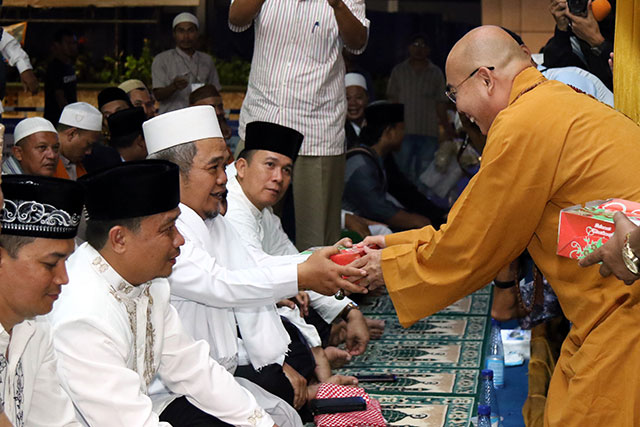
Daily life around Medina echoed this spirit. People visited one another. They exchanged gifts. They accepted invitations, shared meals, and moved through ordinary social rhythms without friction. Difference did not erase humanity.
Seen in full, the Prophet’s life invites a shift in how we read scripture itself. It nudges us toward a broader horizon—one where Islam is lived as rahmatan lil ‘alamin, a mercy to all creation. Not an abstract ideal, but a lived ethic. One that finds expression in akhlaqul karimah—noble character, embodied in everyday interactions.
At its core, the Islamic message is about building life, not tearing it down. The Qur’an speaks of responding to what gives life (Al-Anfal 8:24), of seeking goodness in this world and the next (Al-Baqarah 2:201). These are not calls to domination, but to flourishing.
So when we think about relationships between Muslims and non-Muslims today, the emphasis matters. It should rest on cooperation, respect, and a sense of shared humanity—values deeply rooted in the tradition itself. The ghazawah impulse may be part of the historical record, but it does not define the whole.
If anything, the Prophet’s life points us in another direction. One where alliances cross boundaries. Where dignity is upheld, regardless of faith. Where the goal is not victory over others, but a world in which all can live well.
And perhaps, with a deeper, more honest engagement with that legacy, the vision of Islam as a mercy for all creation can feel less like an aspiration—and more like a responsibility.