
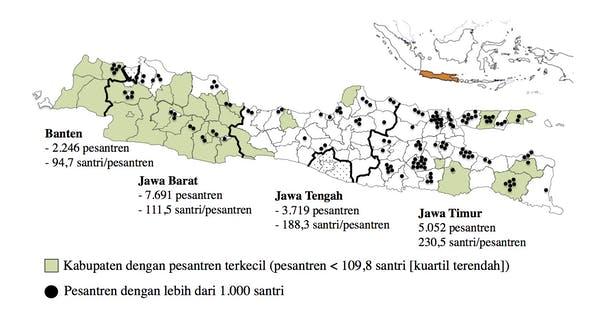
Pelletier’s study shows that out of the six provinces in Java, West Java has the highest concentration of militant Islamic groups and the most frequent instances of mass mobilization. Some areas around West Java have experienced rapid growth in fundamentalist Islamic groups and consistent mobilization efforts.
According to Pelletier, nearly 60% of violent mobilization incidents in Java since 1998 have occurred in West Java, compared to only 10% in East Java.

Pelletier’s conclusions challenge the theory that militant groups like FPI emerged primarily as a result of decentralization and political patronage during the Reform Era. The reality, according to his research, is that these groups have flourished more in West Java, despite political incentives being similar across Indonesia.
He also questions another theory that links the rise of militant groups in West Java to the legacy of Darul Islam, a hardline movement that sought to establish an Islamic state in Indonesia between 1942 and 1962. Pelletier found only a limited correlation between the two. In fact, most leaders of militant groups, particularly at the district and sub-district levels, were clerics (kiai or ustadz) managing small pesantren, prayer groups, or study circles.
The Role of Pesantren
During his research, Pelletier conducted numerous interviews with kiai and members of militant groups, while also utilizing recent data on 15,000 pesantren and 30,000 kiai across Java. His comparative analysis provided fresh insights into the landscape of Islamic institutions in Java.