
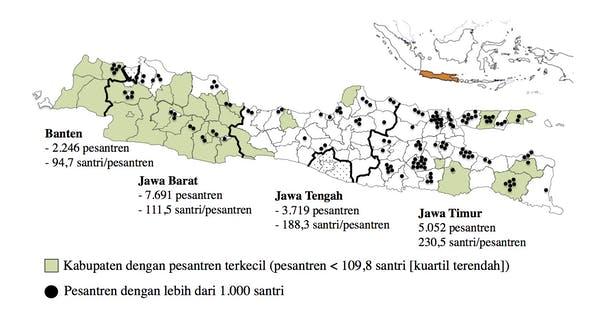
Pelletier’s comparison revealed that while West Java has more pesantren than East Java, the average size of West Java’s pesantren is significantly smaller (WB=111.5 students; EJ=230.5 students). A map produced by the research shows districts with smaller pesantren (marked in green) and those with pesantren enrolling more than a thousand students (marked with black dots) across Java.
In West Java, pesantren tend to be smaller than in other regions. There are only 26 pesantren with over 1,000 students in West Java, compared to 94 in East Java.

This comparative mapping indicates that despite having more pesantren, those in West Java wield weaker authority compared to their counterparts in East Java. In West Java, pesantren are not only smaller but also collectively weaker. The networks between kiai in West Java are more fragmented, informal, and less cohesive than in East Java.
Another important finding from this study concerns the organizational dynamics of religious institutions in West Java. While many people in West Java identify with Nahdlatul Ulama (NU), the largest Muslim organization in Indonesia, NU is neither dominant nor highly influential in this region. Instead, West Java’s Islamic organizational landscape is highly fragmented. Most kiai are either unaffiliated or members of smaller organizations.
From these comparative insights, Pelletier concludes that in West Java, religious elites and institutions have weaker authority, and the competitive nature of this structure creates a fertile environment for the growth of radicalism.
Translated from here.