

The world then wondered: why did Saudi Arabia, the most strict and strict country practising Islamic law, become the mecca of the Muslim world? From there, the message of Islam began, give freedom to women?
Apparently, it all started with Saudi Arabia’s Vision 2030, an ambitious yet transformative vision promoted by the Crown Prince, Muhammad bin Salman (MBS). King Salman mandated that MBS carry out Saudi Arabia’s Vision 2030. Through Vision 2030, the Kingdom of Saudi Arabia will modernize in a revolutionary and visionary manner. Through Vision 2030, Saudi Arabia is determined to become the centre of the Arab and Islamic world, the world’s investment power, and the centre that connects three continents, namely Asia, Africa and Europe.

To realize these ideals, Saudi Arabia no longer wants to “leave” women. Arab women should be encouraged to be actively involved or participate in the success of development programs in all fields. That means Saudi Arabian women must be given the freedom to make life choices, ranging from professional and work issues, entertainment and vacations to how to dress. A small example, for example, is that women there are already allowed to drive their vehicles —something that was previously taboo. Another example is that Saudi Arabian women can attend music concerts or crowd the football field. They can also travel abroad alone. And, the latest example (not necessarily the last one) may no longer wear the hijab —the most important symbol of Muslim women!
Of course, recently, what has happened in Saudi Arabia will again confront most of the world’s Muslims in the debate about aurat—to the pendulum of Islamic formalism. But, of course, we know that it was from Arabia that the message of Islam began, and from there, the teachings of Islam spread to various parts of the world—including the spread of Wahhabism. But, then, in Arab lands, the development of the Muslim world is oriented to trivial things, including how to dress a Muslim, especially Muslim women.
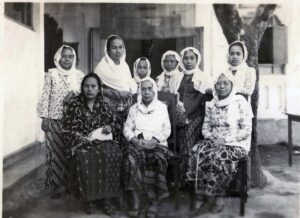
As in many parts of the world, including in Indonesia, at first, the teachings of Islam entered an area by struggling with local traditions, including how Muslims and especially Muslim women should dress. Until the 1970s, the so-called headscarf, hijab, niqab, burqa, or veil were almost unknown to Indonesian Muslim women. A headscarf was commonly worn at that time, a piece of cloth draped over the head. The women or nyai who were active in Muslimah Nahdlatul Ulama (NU) and Aisyiyah Muhammadiyah at that time were also quite veiled in their activities in public spaces.
What is now referred to as Muslim clothing, such as the hijab, hijab, niqab, burqa, or veil, has only become popular in recent years, especially since the Reformation era, along with the influx of transnational ideologies such as Wahhabism and Khilafahism. Until then, the trend of Islamic formalism was so thick that in several public institutions or public schools, there were rules that required every Muslim woman to wear the hijab. In addition, there has been a case where a non-Muslim official was expelled from an area for visiting without wearing a hijab.