
At the most fundamental level, human beings stand equal. Hierarchies belong only to the relationship between the Creator and the created. Among people, differences arise from function and role—nothing more. Beyond that, the rights and obligations we carry stretch across the same terrain: political, social, cultural, even religious.
And yet reality tells a different story.
Within many social constructions, women are quietly—sometimes overtly—cast as the weaker sex. Take property ownership as a simple example: it overwhelmingly bears men’s names. And this, despite the fact that in terms of productive labor, women often put in longer hours—only their contributions tend to vanish into invisibility. What’s more unsettling is this: many women don’t even recognize the structures that confine them.
Gender equality, then, was never about flattening differences or forcing sameness. From the outset, men have been placed a step ahead. What feminism pushes for is something subtler, but far more urgent: fairness. A rebalancing. A call for attention, for space, for recognition—until women can stand shoulder to shoulder with men. The confusion often begins when gender is mistaken for destiny. It isn’t. Biology speaks to sex; gender, on the other hand, is a social agreement—constructed, negotiated, and therefore changeable.
Consider something as ordinary as household responsibilities. There’s nothing inherently “female” about them. These are matters of arrangement, not fate. When couples sit down and truly agree—on roles, on authority, on shared responsibility—what emerges is not conflict, but harmony. Justice, in its simplest form.
The real obstacle lies elsewhere. Patriarchal culture thrives on imbalance. It shapes expectations, molds institutions, and quietly dictates who gets to decide. In many households, wives are still sidelined in decision-making—whether it concerns family matters, reproductive choices, or even their own bodies. The result? A subtle form of domestic authoritarianism, where women’s autonomy is steadily eroded.
Over time, this imbalance breeds something deeper: an identity crisis. Women are left navigating roles they never chose, guided by values they didn’t define. It’s no surprise, then, that many begin to anchor their hopes in stability—often embodied in a financially secure partner. Love takes a back seat; security drives the wheel. Life, in this framing, narrows down to three pursuits: affection, comfort, and a dependable husband.
Ironically, the same social system that restricts women also punishes them for stepping outside its lines. Be too assertive, and you’re labeled harshly. Be too gentle, and you’re praised—but confined. Beauty becomes synonymous with softness. Sacrifice becomes expectation. Even the act of dressing up shifts meaning: no longer about self-expression, but about meeting the gaze—and the desire—of men. In this dynamic, women are rarely subjects of their own stories. More often, they’re cast as objects.
And yet, human nature is anything but static. We evolve, adapt, push boundaries. Patriarchal norms, however, demand the opposite from women: stillness. Compliance. They’re deemed too fragile to lead, too emotional to decide. Which is ironic, considering that women are, quite literally, the bearers of life—the ones through whom human existence continues.
As Lu Yu-Lan points out, women’s emancipation is not a single-issue struggle. It’s a transformation that touches every layer of society. To move forward, three pillars are essential: state support to dismantle the myths that confine women, recognition of both domestic and public labor, and empowerment within the family unit.
Gender itself is not a fixed truth. It’s a set of roles shaped by culture—varying across regions, communities, nations, and faiths. When conflict arises within families, it is often less about individuals and more about the inherited frameworks they operate within—frameworks that rarely rest on true equality.
Gender in the Pesantren Context
Within Islamic discourse, gender equality is often framed as a contemporary issue. Yet a closer reading of the Qur’an reveals something different: a consistent thread of universal values—justice, dignity, and balance. Unfortunately, centuries of uneven interpretation, particularly within classical texts, have sometimes obscured this message. The result is a gap between the Qur’an’s ethical vision and how it is understood in practice.
In the world of pesantren, gender perspectives are deeply influential—but not monolithic. Not every pesantren accepts unequal gender norms without question. In fact, a growing number of scholars and educators within these institutions are actively rethinking the narrative. They advocate for gender equality not as an imported idea, but as something rooted in the Qur’an itself—when read contextually, thoughtfully, and with an eye toward justice.
Islamic studies in pesantren play a pivotal role in shaping religious understanding, including views on gender. Much of the curriculum draws from classical texts—the kitab kuning—which are often grounded in normative fiqh and, at times, reflect patriarchal assumptions. Historically, many scholars positioned women as subordinate to men (Muhannif, 2002), and those perspectives have left a lasting imprint.
In broader society, these imbalances are passed down through generations, often reinforced by religious interpretations. What’s needed now is a more balanced lens—one that distinguishes between what is factual and what is ideal, especially when examining gender roles within pesantren communities.
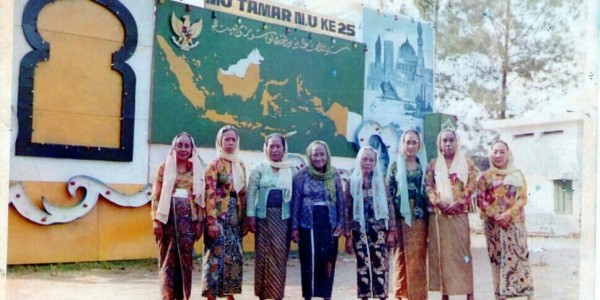
Historically, a significant shift occurred in 1916, when Pesantren Denanyar began accommodating female students. It marked a turning point. For the first time, women had structured access to pesantren education. This change also opened the door for nyai and ning—female leaders within pesantren—to take on roles beyond the domestic sphere, guiding and nurturing female students alongside male scholars.
The separation of male and female students further encouraged pesantren to develop dedicated spaces—both for learning and living—for women. And with that, roles began to shift.
Women in pesantren—whether as nyai or ustazah—gradually stepped into more active positions. No longer confined to managing households or preparing meals, they became educators, caretakers of knowledge, and institutional leaders. Mastery of the kitab kuning and Islamic social sciences was no longer the exclusive domain of men. Some even went further, establishing pesantren specifically for female students—an uncommon move at the time, but a powerful one.
To understand how women navigate leadership within pesantren, three key characteristics come into play: institutional independence, the centrality of the kitab kuning, and the underlying value system (Wahid, 1999). What’s clear is this: women have always been part of the pesantren story. It’s just that research has tended to spotlight the kyai—male scholars—while overlooking the equally vital roles played by women.
That, perhaps, is where the next chapter begins.