
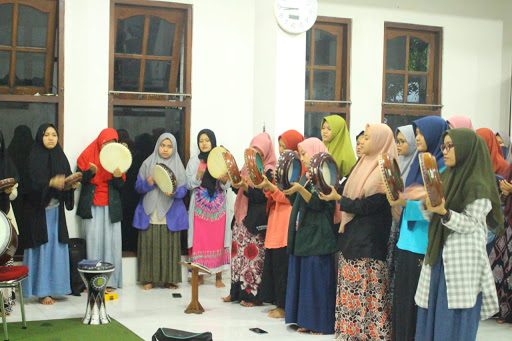
Back when I was still a student—one among many—in a pesantren tucked away in Nglawak Village, Kertosono, life moved to the rhythm of weekly traditions. They weren’t just routines; they were part of the air we breathed. One of the most enduring was the recitation of diba’iyyah, or what we simply called diba’an. Every Thursday night, once the isha prayer wrapped up, we would gather. No reminders needed. For us santri, this wasn’t something optional. It was a given, almost instinctive.
Diba’an, in a broader sense, is deeply rooted in Javanese Muslim culture. You’ll find it woven into life’s milestones: circumcision ceremonies, weddings, thanksgiving gatherings for those departing for or returning from the Hajj, and especially during the month of the Prophet’s birth—what people fondly call muludan. It’s not just an event. It’s a shared expression of devotion.

At its heart, diba’an is a collective act of remembrance—reciting praises and blessings upon the Prophet Muhammad, peace be upon him. The rhythm shifts throughout: some passages are spoken plainly, others carried in melody, rising and falling in unison. The name itself traces back to a revered work composed by al-Imam al-Jalil, Sayyid Shaykh Abu Muhammad Abdurrahman ad-Diba’iy asy-Syaibani az-Zubaidi al-Hasaniy. Most people simply know it as Maulid Diba’.
Syaikh Abdurrahman ad-Diba’iy was born on the 4th of Muharram in 866 Hijri and passed away on a Friday, the 12th of Rajab, 944 Hijri, at the age of 78. He wasn’t just a scholar—he was a towering figure in hadith studies, reaching the rank of hafiz, someone who had committed 100,000 hadith to memory along with their chains of transmission. Beyond that, he was also a historian of note. His works span a wide range, including Taisirul Wusul ila Jami‘il Usul min Hadithir Rasul, Qurratul ‘Uyun fi Akhbaril Yaman al-Maimun, and Bughyatul Mustafid fi Akhbar Madinat Zabid, among others.
The Maulid Diba’ itself tells the story of the Prophet in a style that feels almost like a love letter—prose that flows with elegance, interwoven with verses brimming with longing and reverence for God’s chosen beloved. When we recite it, we’re not just reading text; we’re stepping into that emotion, letting it echo through our voices. Diba’an, then, becomes more than tradition—it’s an offering of love.
Within the pesantren, though, its role runs deeper. It quietly shapes character. It teaches patience, togetherness, and above all, tolerance. Because not everyone sees diba’an the same way. There are groups who regard it as bid‘ah—an unwarranted innovation. For them, commemorating the Prophet’s birth, especially through poetic recitations like Maulid Diba’, al-Barzanji, or al-Burdah, crosses a line. Some even argue that the narratives are fabricated or that the praises verge on excess, bordering on shirk.
And yet, this is where the lesson lies.
Tolerance isn’t just a concept we talk about—it’s a posture we choose. It means holding space for differences without letting them fracture our unity. For Muslims in the archipelago, diversity in practice has long walked hand in hand with shared faith. Traditions like diba’an don’t stand in opposition to Islam; they grow within it, shaped by culture, history, and collective memory.
At the end of the day, every Muslim hopes for the intercession of the Prophet in the hereafter. That longing is universal. But the paths we take to express that love? They branch out in countless directions. Not identical, but aligned in purpose.
So perhaps the question isn’t which path is right, but whether we can honor each other’s journeys along the way. Because if there’s one thing Islam consistently calls us toward, it’s this: to live with grace, to embrace difference, and to let faith unfold in ways that enrich rather than divide.
Wallahu a’lam bisshawab.