
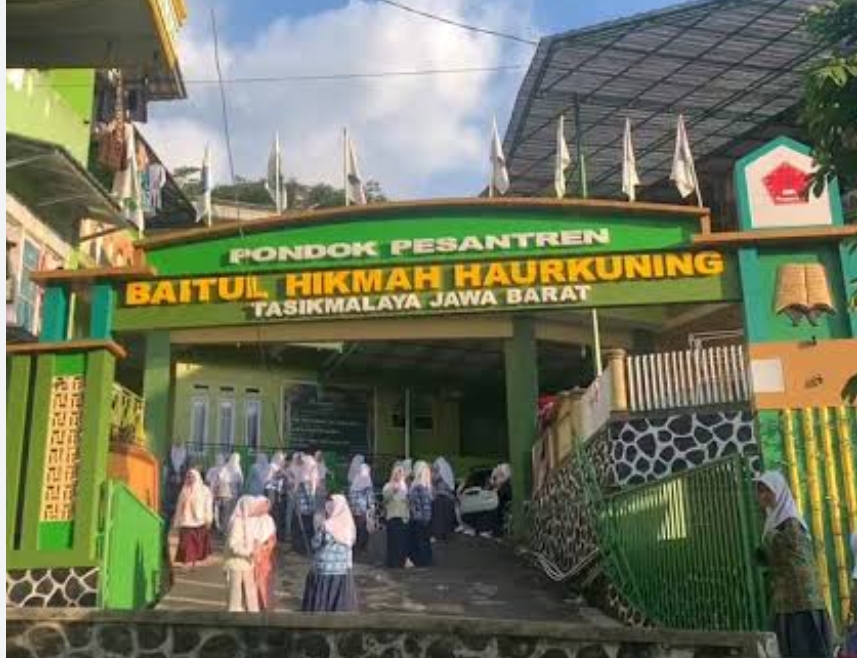
The teaching style leaves little room for passivity. Students are expected—almost inevitably—to memorize key verses drawn from a range of classical nazham. Take something as basic as mubtada’ (the subject of a nominal sentence). A student won’t just learn the definition; they’ll be asked to recall its foundational rules across multiple texts—Jurumiyah, Nazhmil Maqshud, Imrithi, even Alfiyah.
So it’s no surprise that, even before formally studying Alfiyah, many Haurkuning students already have 30–40% of its verses committed to memory.

Reasoning and “Tatalaran”: The Living Core
Beyond formal lessons, what truly shapes a Haurkuning student happens outside the classroom. Two practices stand at the center of everything: nalar and tatalaran. They may sound similar, but here, they serve distinct roles.
Nalar is essentially the memorization of classical texts—tahfizhul mutun. Both prose and poetry. Students work through foundational works like Matan Jurumiyyah, Imrithi, Nazhmil Maqshud, Alfiyah, Tarshif, Sullam Munauraq, Jauhar Maknun, and more. For sansus students—those who’ve completed formal high school—additional texts like Baiquniyyah and Rahbiyyah come into play.
Each level carries its own targets. A first-year senior-level class (ibtida B), for example, is expected to complete memorization of Jurumiyah, Imrithi, Nazhmil Maqshud, and around 100 verses of Alfiyah within a year. It’s demanding—especially for beginners. Still, even reaching half or two-thirds of that target is considered meaningful progress. Evaluations happen regularly, at least twice a week.
Tatalaran, on the other hand, is more collaborative. It’s group-based learning focused on the fundamentals of sharaf. Small groups—sometimes formed by dorm, sometimes by class—work under the guidance of senior students.
And it’s relentless. Three times a day, minimum: after dawn, after noon, and before bed. Sometimes more. If there’s free time, it rarely stays empty.
The material covers the nuts and bolts: tashrif isthilahi, tashrif lughawi, the seven forms of bina’, i‘lal transformations, parsing (i‘rab) texts like Jurumiyah, and other core principles. Through these sessions, students build a solid foundation—one that prepares them to navigate far more complex disciplines later on.