
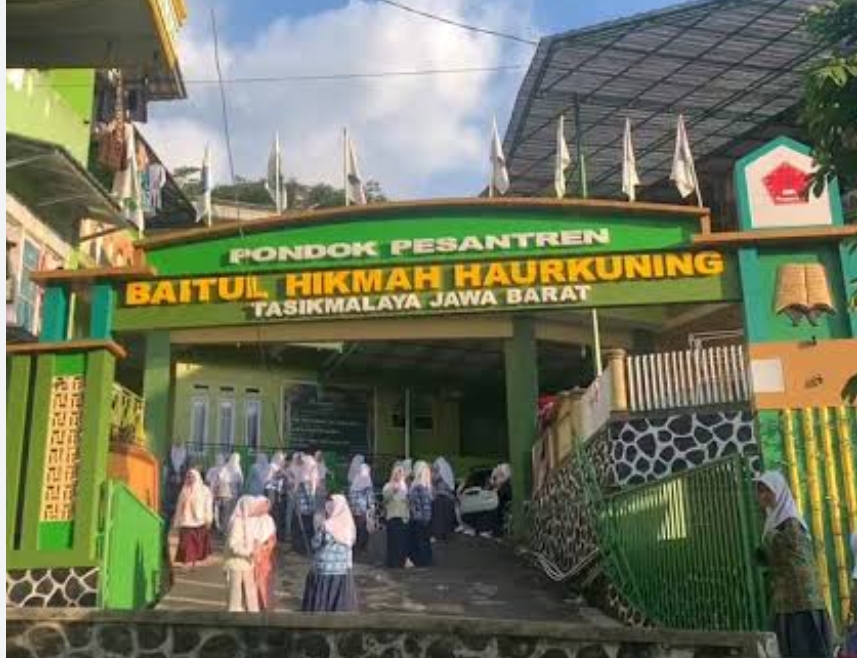
Among the sarong-clad circles of West Java, the name Haurkuning carries weight. Say it out loud, and people will nod almost instantly—“Ah, that’s the place with the brilliant students.” Not just bright, but sharp in a very particular way. Their strength lies in ilmu alat—the linguistic tools of Arabic scholarship, a field many consider notoriously tough to master. Add to that a style that feels unexpectedly refined, even a little polished for a traditional salaf pesantren, and the reputation only grows stronger.

Officially, the institution is called Baitul Hikmah. “Haurkuning” comes from the name of the village where it stands. Literally, it means “yellow bamboo.” Whether the area was once thick with golden-hued bamboo is anyone’s guess. What’s certain is that even today, patches of yellow bamboo still grow quietly in corners of the compound.

There’s another story, though—one that drifts into a more poetic register. Some trace the name back to the Arabic ḥūr (heavenly maidens) and qanā‘ah (a state of contentment, of accepting what God provides with a full heart). That’s why, in Arabic script, the “k” in Haurkuning is written with a qaf, not a kaf. A small detail, perhaps, but one that hints at deeper layers of meaning.
Founded in 1964 by the late KH Saepudin Zuhri, the pesantren sits in Dusun Haurkuning, Desa Mandalaguna, Kecamatan Salopa, Tasikmalaya. Over time, it has carved out a clear identity: this is where students come to get serious about nahwu and sharaf—Arabic grammar and morphology in their most rigorous forms.
And the results speak for themselves. At district-level competitions, for instance, Salopa—dominated by Haurkuning students—almost always walks away as the overall champion. The real question is: how does the system work? What kind of learning environment produces this level of mastery? Let’s take a closer look.
A Curriculum Rooted in Classical Texts
At the heart of Haurkuning’s curriculum are two pillars: Jurumiyah and Alfiyah. Each year, students move up a level, but Jurumiyah never loses its place. Whether at the beginner (ibtida), intermediate (mutawasith), or advanced (mutaqaddim) stage, it remains a constant companion. The difference lies in depth—the higher the level, the more layered and comprehensive the discussion becomes.
Alfiyah enters the formal curriculum a bit later—typically in the third year for senior-level newcomers, and the fourth for junior-level ones. Still, even first- and second-year students are no strangers to it. They’re introduced to the text early on, long before they formally “study” it.