

Throughout history, as is the case in Indonesia, mosques have often served not only as places of worship but also as hubs for the dissemination of knowledge and the movement against colonialism. The Masjid Kebondalem, located in the village of Argomulyo, Sedayu sub-district, Bantul Regency, Yogyakarta, stands as a silent witness to the role of mosques as centers for the dissemination of knowledge and the struggle against colonial powers for the surrounding community.
In the history of Islam’s spread in Indonesia, Masjid Kebondalem is recorded as one of the oldest mosques in the Nusantara. It was established by Kiai Muhammad Shareh, an Islamic scholar who propagated Islam in the Sedayu region. The mosque has stood since the 18th century AD.

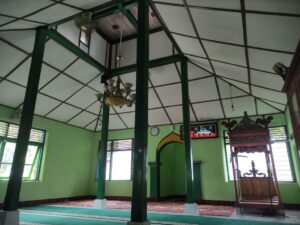
Initially, Masjid Kebondalem was constructed with bamboo walls. This mosque’s construction was one of the endeavors in Kiai Shareh’s struggle to spread the teachings of Islam. Through Masjid Kebondalem, Kiai Shareh successfully encouraged the local community to not only worship but also to acquire religious knowledge from him.
However, Kiai Shareh’s struggle to spread Islam in Sedayu was not without challenges. Perhaps due to its bamboo structure, the mosque eventually fell victim to a devastating fire. All that remained were ashes and rubble. According to Nuryanto’s account (Interview Nuryanto: 2023), the fire was ignited by a falling oil lamp (ublik), which swiftly engulfed the mosque.
Subsequently, the mosque was rebuilt with the same material. It was only during the time of Kiai Shareh’s son, Kiai Khalifah, that Masjid Kebondalem could be permanently reconstructed with concrete and brick. According to Bibit’s account (Interview Bibit: 2023), Kiai Khalifah was closely associated with Prince Diponegoro, holding the title of Pangeran Cokro Kertopati.
Under Kiai Khalifah’s leadership, Masjid Kebondalem witnessed an increasing number of people coming to learn from him and seek religious knowledge. Masjid Kebondalem continued to flourish and became a center for the education and community development in the realm of religion. This rapid growth coincided with the events of the Java War (Perang Diponegoro).
As per family accounts, Kiai Khalifah left the mosque to participate in Prince Diponegoro’s battles (Interview Ibnu Arofah: 2023). Within the Network of Ulama of Prince Diponegoro in the 20th Century (Bizawie, 2019), Kiai Khalifah had a documented history of involvement in the Diponegoro War. This lineage can be traced through the genealogy of Kiai Khalifah’s wife, who was connected to Pangeran Diponegoro as the grandson of Sultan Yogyakarta II (HB II). The genealogy from Kiai Khalifah upwards, from Kiai Khalifah to Kiai Muhammad Shareh Kebondalem to Kiai Sahid Yogyakarta to Kiai Imam Mursyid (Syekh Abdul Mursyid) known as Cokroaminoto Sendang Pitu, Kiyudan, Yogyakarta. It is said that Sultan Agung once studied under Kiai Imam Mursyid.
After Kiai Khalifah’s departure, the abandoned mosque was maintained and cared for by the family and the local community. At the time, Kiai Khalifah left without leaving any message regarding his destination or purpose. While awaiting news of his whereabouts, the people of Sedayu could do nothing but pray for his safety.