
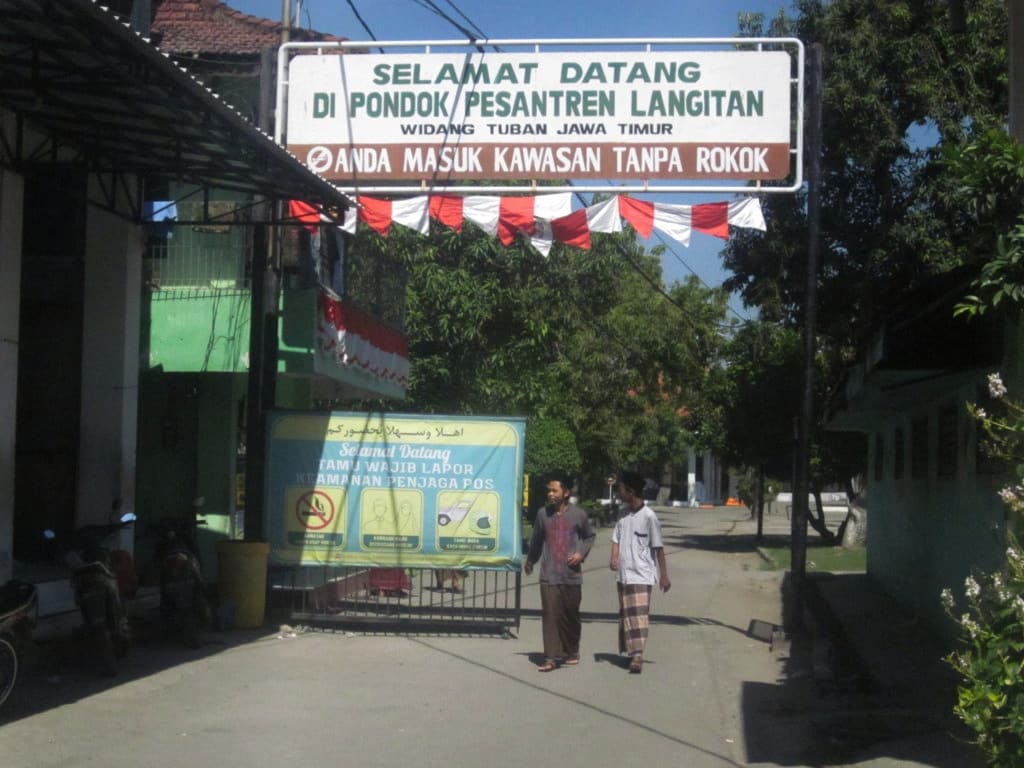
As one of the oldest Islamic boarding schools in East Java, Pondok Pesantren Langitan in Tuban has produced countless scholars who have spread across Indonesia. Today, it is formally known as Al-Ma’had al-Islamy al-Syafi’i, yet the name “Langitan” remains deeply ingrained—impossible to erase, firmly attached to its identity.
In its earliest days, Langitan was built on farmland along the northern bank of the Bengawan Solo River. Because the area was prone to frequent flooding, the pesantren was relocated in 1904 to a safer site north of Tangkis, right by the provincial road connecting Tuban, Babat, and Surabaya.

Tuban itself, a bustling coastal town along the northern shoreline of East Java, holds a significant place in Indonesia’s historical journey. Beyond its role as an important trading port, it also became a center for Islamic development alongside regions like Sedayu, Gresik, and Surabaya. Widang—where Langitan stands—was particularly lively. Its proximity to the Bengawan Solo made it a strategic route for trade and mining, connecting inland regions with coastal markets and attracting merchants from major cities.
The origin of the name “Langitan” comes in several versions, each complementing the other. The first traces it back to Ngelangitan, derived from the Javanese words ngelang (to swim) and wetan (east). This refers to a story of a man performing spiritual discipline by swimming across the Bengawan Solo seven times from west to east. On his final crossing, he emerged from the water and encountered Sheikh Muhammad Nur—marking the birth of what became known as Pesantren Ngelangitan.
Another version suggests the name evolved from Plangitan, a combination of plang (signboard) and wetan (east), referring to the pesantren’s location near a place called Plangwetan. Over time, the name Plangitan became associated with the pesantren. This account is supported by one of its caretakers, KH Ahmad Marzuki Zahid.
During its pioneering phase, Langitan was led by KH Muhammad Nur, a respected Islamic teacher from Tuban. He began by holding religious gatherings from house to house, or at his own home, on farmland along the riverbank. These lessons were typically conducted after the Asr and Maghrib prayers.
His method of teaching drew increasing attention, encouraging many parents to send their children to study with him. This growing interest eventually led KH Muhammad Nur to establish a langgar (small prayer hall), dormitories, and other essential facilities.
Over time, Langitan grew rapidly. KH Muhammad Nur led the pesantren for 18 years before passing away on 30 Jumadil Awwal 1297 H. Prior to his death, leadership had already been entrusted to his son, KH Ahmad Shaleh. After KH Ahmad Shaleh’s passing, leadership transitioned to his son-in-law, KH Chazin, who guided the pesantren for 20 years.
These two periods following the founding era marked a phase of significant growth. After KH Chazin passed away in 1340 H/1921 CE, leadership was handed to his son-in-law, KH Abdul Hadi Zahid. It was under his stewardship that Langitan underwent a remarkable transformation, particularly in its educational system.
The Figure of KH Abdul Hadi Zahid
KH Abdul Hadi Zahid was born on 17 Rabiul Awwal 1309 H in Kedungpring, Lamongan, East Java. He was the eldest son of KH Ahmad Zahid and Nyai ‘Alimah. His father was a prominent religious teacher and respected scholar in Kauman Kedungpring. From a young age, he began studying the Qur’an, the classical text Safina an-Najah, and practicing religious rituals under his father’s guidance. He later continued his education at Pesantren Kemisik in Lamongan, where he studied tajwid, Ummu al-Barahin, and other disciplines under Kiai Abdul Malik.
At the age of eleven, he moved to Pondok Pesantren Langitan, where he spent eight years deepening his knowledge of fiqh, theology, ethics, Arabic grammar, and Sufism under KH Chazin. He also studied for three years under the renowned scholar KH Kholil of Bangkalan at Pesantren Kedemangan in Madura. His pursuit of knowledge did not stop there. At 23, he continued his studies at Pesantren Jamsaren in Solo, focusing on fiqh under Kiai Idris, a leading scholar of the early 14th Hijri century.
After years of study, he returned to Langitan—not only as a student, but also as a teacher, assisting in educating younger santri. His dedication led KH Chazin to take him as a son-in-law, marrying him to his daughter, Nyai Djuwairiyah, when he was 25. By the age of around 30, KH Abdul Hadi Zahid had already assumed leadership of the pesantren.
He was known for his perseverance and optimism. Guided by the principle “al-muhafadlotu ‘ala al-qodim as-sholih wa al-akhdhu bi al-jadid al-ashlah”—preserving what is good from the past while embracing what is better from the present—he introduced meaningful reforms across education, organization, and infrastructure. In 1949, he established formal education systems such as Madrasah Ibtidaiyah Falahiyah and Madrasah Mu’allimin Langitan, while still maintaining traditional methods like sorogan and wetonan.
During the transition from Dutch to Japanese rule, all activities at Langitan were temporarily halted. Many students returned home to join guerrilla resistance movements, while the pesantren complex was occupied by Japanese forces. Archives and documentation were destroyed and burned.
From 1945 to 1949, during the revolution, the closure continued as many santri joined the Sabilillah forces headquartered in Malang. After the revolution, in 1961, traditional study sessions resumed—this time open to both male and female students. The Madrasah Ibtidaiyah Falahiyah was reactivated in 1969, along with the introduction of a Madrasah Tsanawiyah level.
Under his leadership, extracurricular activities flourished. Organizational development was strengthened through the establishment of internal institutions such as Jam’iyatul Mubalighin (1960), focused on public speaking; Jam’iyyatul Qurro’ wal Huffadz (1961), dedicated to Qur’anic recitation; KESPOL (1966), a family organization within the pesantren; and Majelis Bahtsul Masail al-Waqiah (1967), a forum for discussing contemporary legal issues in Islamic jurisprudence.
As the number of students grew, facilities were expanded—dormitories for male and female students, school buildings, prayer halls, bathrooms, wells, and more. The library collection was also enriched with books in Indonesian, Arabic, and English. At its peak during this period, the pesantren housed around 600 students from various regions across Java, Madura, and even Sumatra.
KH Abdul Hadi Zahid led Langitan for nearly 50 years. It was a long tenure—yet one marked by deep transformation and steady progress. He passed away in 1391 H/1971 CE and was laid to rest in the family cemetery in Widang. After his passing, leadership of the pesantren was continued by KH Ahmad Marzuki Zahid and KH Abdullah Faqih.