
Anderson’s thesis remains important because it explains nationalism as a cultural phenomenon born from media, rather than from ethnic or religious “destiny.” But the framework is still rooted in European modernity. It misses other routes by which collective consciousness may form—for instance, through networks of ulama, pesantren, and religious texts that circulated through manuscripts before the era of mass print capitalism.
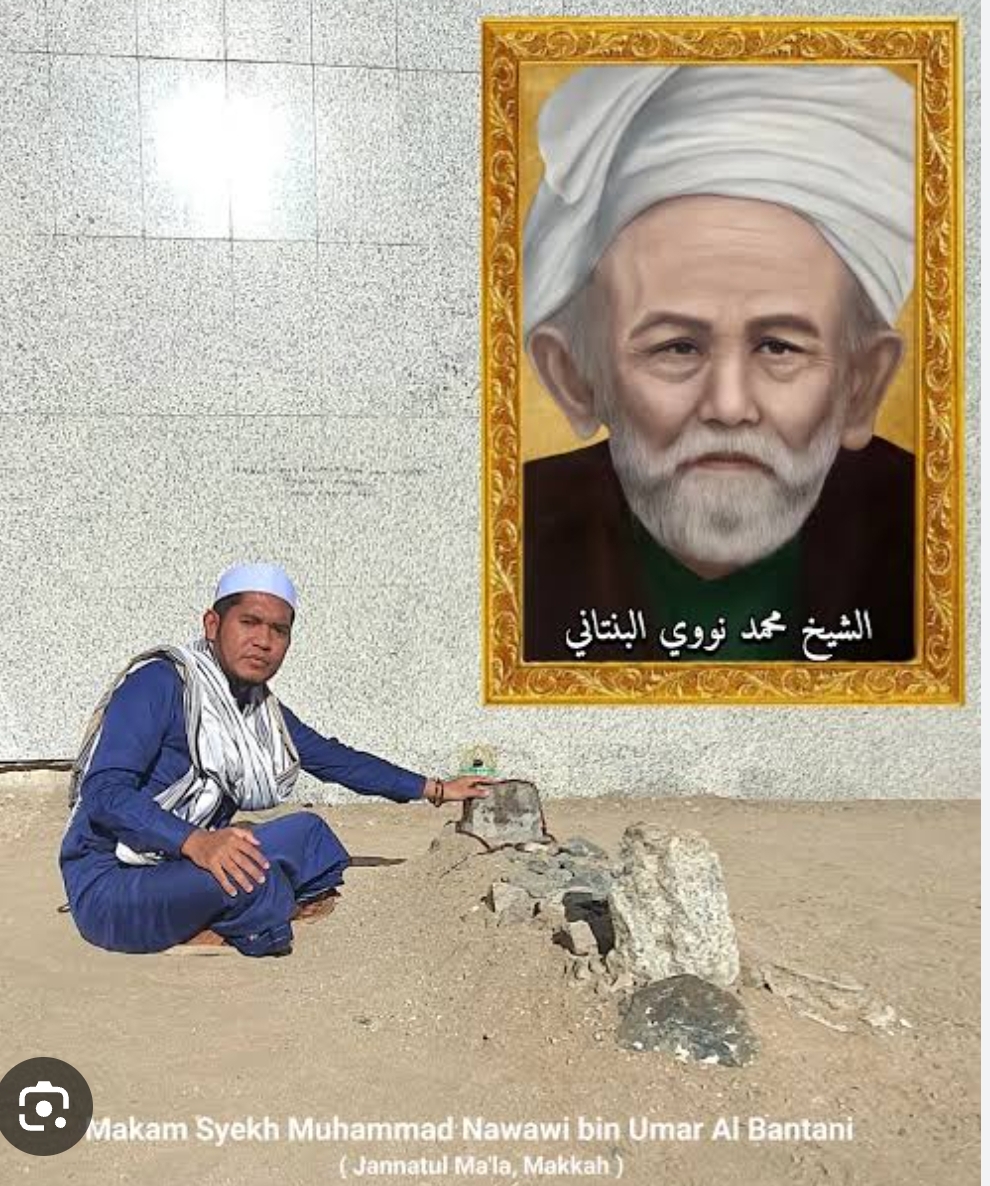
That is precisely where Sheikh Nawawi al-Bantani’s thought, with the al-Jâwî identity he asserted in his books, can be read as an embryonic national consciousness that differs from the route imagined by Anderson. Put differently, Anderson’s theory of nationalism, powerful as it is, remains grounded in European experience. The archipelago had another path: the path of kitab kuning, Sufi orders, and the courtyards of pesantren.

In this sense, the pesantren intellectual tradition offers a route different from the one Anderson describes. For Anderson, nationalism emerges from newspapers, vernacular language, and print capitalism. But for the pesantren world, collective consciousness grows from kitab kuning—whether copied by hand or later printed—and above all from sanad, stretching across generations, and from oral teaching in prayer halls and village schools.
The identity al-Jâwî that Sheikh Nawawi affirmed in his books turned the community of his students and readers into a pesantren-style imagined community: they did not know one another personally, yet they felt connected through a shared scholarly lineage and cultural identity that transcended regional boundaries. Here, the embryo of nationalism was born not from the modern print market, but from the spirituality of classical texts, the network of scholars, and the subtle pledge of a Banten scholar in the holy land.
This is where Sheikh Nawawi opens a different route—one that both expands and corrects Anderson’s thesis. If Anderson emphasizes newspapers and print capitalism as the engines of imagined communities, Sheikh Nawawi shows how a similar community may be formed through religious books copied by hand, transmitted, and taught across pesantren. Students in Tanara, Caringin, Bangkalan, across Java and as far as Sulawesi, read or heard the same texts from a teacher, referred to the author as al-Jâwî, and felt themselves linked by ties of learning and collective identity.
In other words, nationalism along the pesantren route did not emerge from the modern reading room, but from the traditional halaqah; not from the simultaneity of the morning newspaper, but from the continuity of sanad linking teacher and disciple across generations. It was in those quiet spaces that national imagination was sown, with the kitab kuning as its medium, and love of homeland as the spirit burning within it.
At first, Sheikh Nawawi’s books circulated in manuscript form through the handwritten culture of copying. Students brought lesson notes home from Mecca, copied them again in pesantren, and passed them on to other students, who copied them again and again. That is how works like Nashâih al-‘Ibâd or Syarh Kâsyifah al-Sajâ first became known and circulated through pesantren long before they were printed.
Then, in the 1880s, Sheikh Nawawi’s works began to enter the world of modern printing in Cairo and Bombay—Marâh Labîd, for example, was first printed in Egypt in 1887. From that point on, his books traveled along two routes at once: they remained alive in the manuscript tradition of pesantren, while also circulating through print capitalism, which enabled them to cross geographic borders more quickly.
That dual position is what makes him so interesting. On the one hand, Sheikh Nawawi inherited an older mode: an imagined community formed through sanad and manuscript. On the other, he entered the modern orbit of print, widening the reach of his readership. For that reason, he can be seen as a bridge: the womb of nationalism born from silent manuscripts in pesantren rooms, and at the same time an early actor who made use of print capitalism to spread knowledge throughout the archipelago.
Even though Sheikh Nawawi can thus be called an early actor in the orbit of print capitalism—with Marâh Labîd already published in Cairo in 1887, and other works circulating in Singapore, Penang, and Batavia—he still slips past Anderson’s lens. Why? Because Anderson limits “print capitalism” to newspapers and novels in vernacular languages, while Sheikh Nawawi wrote in scholarly Arabic and distributed his works through pesantren networks. Yet those very books formed an imagined community of santri across the archipelago, from Tanara to Sulawesi. In that sense, Sheikh Nawawi reveals a side of print capitalism that Anderson’s camera misses: in the archipelago, the embryo of nationalism was born not only from secular modern media, but also from religious texts that bound the community together in the language of faith and scholarly tradition.
So there he was, in the quiet alleys of Mecca, teaching not only knowledge, but a love of homeland that never shouted, yet ran very deep. He never said “Indonesia”—because that political entity did not yet exist—but he named his homeland, Banten, with an undying longing. He wrote with the nisbah “al-Bantani,” not merely as a geographic marker, but as a spiritual pledge: that the knowledge he taught was meant to liberate his birthplace from ignorance and subjugation. All of this spread across the archipelago through manuscripts and print capitalism. So Sheikh Nawawi is not an exception to Anderson’s theory. He is evidence of an alternative path of nationalism, one that may in fact be more relevant for understanding Indonesian history.
And once again, this is where Sheikh Nawawi widens and corrects Anderson’s thesis. If Anderson says the nation is an imagined community born through print media such as newspapers, Sheikh Nawawi shows another path: imagined community can also be born through kitab kuning and the sanad of pesantren.
This approach becomes even more compelling when placed alongside Steven Grosby’s framework (2011), which understands nationalism as a primordial social bond stretching back to ancient times, rooted in territorial boundaries—sacralized attachment to homeland—and strengthened by religion as a source of collective identity. For Grosby, the nation is not an invention of the nineteenth century, but a primordial human impulse to form communities bound to territory, like ancient Israel bound by divine covenant, shared law, and the distinction between “us” and “them.”
As a primordialist thinker of nationalism, Grosby sees religion as a basic element in the formation of nationalism through humanity’s foundational social bonds. Nations are not merely modern constructs, but transcendental impulses to form communities tied to land. Religion—whether Judaism, Christianity, or Islam—sacralizes territory, turning it into homeland endowed with deep spiritual meaning, thereby creating a collective sense of belonging that transcends time.
Specifically in the Islamic context, Grosby (2011: 126–127) cites Ibn Khaldun (1332–1406), who in the Muqaddimah explains how cohesive group solidarity (‘ashabiyyah) forms the collective consciousness of Muslim communities. According to Grosby, ‘ashabiyyah “strengthens a collective self-consciousness of kinship beyond its literal reference to family, extending to attachments found among neighbors, allies, and the state (dynasty).” In this light, ‘ashabiyyah is not merely blood or tribal solidarity, but a primordial force that unites the community against external threats such as colonialism, making territory into a sacred homeland that must be defended. This aligns closely with the way Sheikh Nawawi, through his al-Jâwî identity, built a collective solidarity of the archipelago that surpassed local boundaries, sowing seeds of resistance rooted in the shari‘a and scholarly sanad.
Grosby goes further, highlighting how the Islamic concept of ummah is unified by narratives of migration and struggle that turn geography into sacred space requiring defense—much like Canaan in Jewish tradition or holy land in Christianity. Religious law, such as the shari‘a, functions as a shared moral framework governing collective life, legitimizing just authority while providing grounds to reject tyranny. In that way, religion strengthens national cohesion through divisiveness—the distinction between “us” (the faithful community) and “them” (outsiders or enemies). This is not conflict for its own sake, but the historical basis of solidarity, with religion serving as an emotional adhesive of identity, especially in the face of colonial threat.
Grosby analogizes the formation of Muslim collective consciousness to that of Jews and Christians: shari‘a as divine law, akin to Torah or church canon, creating a political-moral order that binds the community together, where fidelity to shari‘a becomes a pledge of loyalty to territory and collective identity. The distinction between “us” and “them” is not only external—Muslims versus non-Muslims—but internal as well, encompassing differences of school or ethnicity within the ummah, which in fact enrich the broader cohesion. Grosby stresses that Islamic nationalism arises from this tradition, where religion provides the historical “chain links” that transmit a spirit of resistance, making it an authentic form of collective consciousness rooted in territory, law, and identity distinction—not merely a political ideology, but something perennial in human life.
Through Steven Grosby’s lens, nationalism appears as a primordial phenomenon shaped by religion. In that light, Sheikh Nawawi al-Bantani emerges as a key architect in forming the archipelago’s collective self-awareness.
First, through a sacralized attachment to territory, Sheikh Nawawi consistently identified himself as “al-Tanârî, al-Bantanî, al-Jâwî” in his works. These affiliations were not just geographic markers, but spiritual and emotional declarations that the archipelago—especially Banten—was homeland with transcendent meaning, something to be protected and defended. Though he lived in Mecca, his ink became a spiritual bridge connecting Muslims in the archipelago to the center of Islamic learning, while at the same time sacralizing Banten as the point of departure for collective consciousness. This fits Grosby’s view that religion gives sacred attachment to territory, transforming land from mere geography into a source of dignity and identity worth struggling for. Sheikh Nawawi’s exegesis forbidding obedience to unjust rulers—in the context of Dutch colonialism—becomes a rejection of foreign interference that defiles the sanctity of homeland, casting Islam as the protector and liberator of the land.
Second, Sheikh Nawawi shaped nationalism through shared law (shari‘a) and the distinction between “us” and “them,” which resonates with Grosby’s primordial divisiveness. His books, such as Marâh Labîd with its interpretation of ulî al-amr, taught not only ritual but also principles of justice and Islamic morality that became the basis of social and political order. The shari‘a he taught insisted that obedience is legitimate only when grounded in justice, thereby implicitly rejecting the legitimacy of oppressive Dutch colonial power. This formed a collective identity of “us”—the Muslims of the archipelago rooted in shari‘a—clearly distinguished from “them”: tyrannical colonial rulers and cruel indigenous collaborators.
The sanad and pesantren networks he built became the “chain links” through which this consciousness was transmitted, binding students and scholars across generations in a primordial social relation, in Grosby’s sense, that encouraged resistance. In this way, Sheikh Nawawi taught not only religion, but also sowed the seeds of a shari‘a-based moral nationalism, forming an al-Jâwî community inwardly bound by Islam and outwardly united against colonial threat.
In Grosby’s framework, the nation planted by Sheikh Nawawi al-Bantani through the identity al-Jâwî and his sanad networks is a strong primordial foundation—a social bond rooted in sacralized territoriality (Banten-archipelago as homeland sanctified by faith), a shared shari‘a (as in the exegesis of ulî al-amr delegitimizing tyrannical rulers), and the distinction between “us” (the Muslims of the archipelago) and “them” (colonial occupiers). This was not nationalism as a modern political ideology demanding a nation-state, but nationhood as an inherent and enduring structure, akin to the ancient communities Grosby describes. Sheikh Nawawi planted these seeds through books circulated via manuscripts and pesantren, forming a collective self-awareness rooted in Islamic tradition—a “womb of nationalism” that was calm, slow-burning, like embers banked in a furnace, ready to flare when history demanded it.
And those seeds became nationalism in the hands of his students who engaged colonialism directly, much like Sheikh Nawawi’s embers becoming flame in their hands. Students such as Sheikh Mohammad Arsyad Thawil (involved in the 1888 Banten Revolt and exiled to Manado), Sheikh Asnawi Caringin (imprisoned for the resistance of 1926), Syaikhona Khalil Bangkalan (arrested by the Dutch for anti-colonial activity in Madura), and Hadratussyekh Hasyim Asy‘ari (who ignited the 1945 Jihad Resolution through Nahdlatul Ulama) actualized Sheikh Nawawi’s primordial nationhood into active nationalist struggle—an ideology demanding sovereignty and liberation.
This aligns with Grosby’s distinction: Sheikh Nawawi’s nationhood as a stable underlying structure—primordial, religious, traditional—transformed into nationalism as divisive action against external threat, with shari‘a as the moral weapon defending homeland. The quiet embers Sheikh Nawawi tended in Mecca blazed into revolutionary fire in the pesantren of the archipelago, proving that Islamic nationalism did not arise from Andersonian print capitalism, but from the route of kitab kuning and sanad tying generations together.
So Sheikh Nawawi was not merely an early actor in print capitalism. He was an architect of the perennial nationalism Grosby describes: a spirit rooted in Banten’s soil, spreading through spiritual networks, and shaping a collective identity that transcends time. The wind of Tanara carried not only longing, but sacred seeds of nationhood, where knowledge became a territorial weapon against injustice.
That sense of nationhood—that nationalism—did not come from flags, nor only from manuscripts and print capitalism, but also from sanad, the chain of intellectual and spiritual transmission. Sheikh Nawawi’s students became guardians of that spirit in their respective regions. They built pesantren as fortresses of the soul, spreading Sheikh Nawawi’s teachings as a light that refused colonial domination. They never used the word “patriotism,” but they lived as spiritual patriots: defending the homeland with knowledge, with prayer as a mode of transmitting discourse, and with a courage that did not seek applause. It is this kind of nationalism that Sartono Kartodirdjo (1984: 221) paradoxically called “Islamic nationalism.”
And it is precisely in sanad that another crucial dimension of nationalism’s formation lies. Sanad does indeed preserve the inner bond between teacher and disciple—a bond that is not mere transfer of knowledge, but a meeting of souls across intellectual, moral, emotional, and spiritual dimensions all at once. It is breath handed down, spirit entrusted, from one generation to the next. But more than that, it also nurtures emotional ties among fellow students who drink from the same spring of knowledge, joined within one sacred genealogy of learning. A teacher becomes the inward link among all his students—past and future—binding scattered hearts into one extended family of knowledge and humanity. In that way, they form an imagined community with a collective identity.
So the nationalism born from the womb of the pesantren contains both continuity and anchoring: an unbroken thread connecting past and future, and a fixed point that stabilizes shared identity. It is vertical and horizontal at once—a cross of imaginary axes from which the whole structure of national consciousness hangs, where love of knowledge and love of homeland become inseparable. Sheikh Nawawi is the knot to whom the inner worlds of all his students are vertically tied. His students, spread across the archipelago, become the ropes of horizontal sanad, linked to one another. They form networks, imaginatively and historically, through a shared intellectual-spiritual spirit from the same teacher. In that sense, the growth of nationalism in the pesantren courtyard becomes even stronger because it is bound together in and by the imagination of sanad. Intellectual-spiritual genealogy becomes a space of imagined collective identity that deepens the patriotism and nationalism handed down by a teacher.
Sheikh Nawawi was a patient planter. He knew the tree of nationhood would not grow overnight. But he planted with love, watered with knowledge, and allowed the spirit to grow in the soul of the community. So when the dawn of nationalism broke in the early twentieth century, the soil was already ready—because its seed had been planted by a scholar who wrote in silence, yet shook the soul. In that sense, Sheikh Nawawi prepared both the boat and the sail: the boat as a solid scholarly foundation, the sail as the spiritual energy ready to catch the winds of the age. He himself may not have lived to see that boat set out, but he had already determined its direction. From what he planted grew a forest of values; from the boat he prepared departed generations who would navigate the waves of history.
Through the channels already described—the construction of an al-Jâwî identity, political-moral exegesis such as his reading of ulî al-amr, and the sanad networks that kept his teachings alive—the mechanism behind Nina H. Lubis’s statement becomes clear. Nina H. Lubis (2003: 99) writes, “It was Sheikh Nawawi who pumped the spirit of struggle against colonialism.” Nina Lubis does not explain what this “pump” actually was. But it is now clear that what she called the “pump” was nothing less than the entire intellectual-spiritual ecosystem Sheikh Nawawi built from Mecca. This essay therefore does not merely confirm Nina Lubis’s statement; it goes further by showing how that “pump” worked—not through shouting, but through ink affirming identity, justice, and an unbroken spiritual chain.
That is the sense in which Sheikh Nawawi was a womb of nationalism, giving birth to the energy of resistance in its most organic, deepest, most rooted, and most enduring form. That spirit became concrete action in figures such as Sheikh Arsyad Thawil, exiled to Manado; Sheikh Asnawi Caringin, imprisoned by the Dutch in Batavia; Syaikhona Khalil Bangkalan, detained by the Dutch in Madura; and Hadratussyekh Hasyim Asy‘ari, who ignited the Jihad Resolution in Surabaya.
Multatuli: Literary Resistance from the Wound of History
After making our pilgrimage to Sheikh Nawawi in Mecca, let us continue our voyage to Amsterdam. In that city built on the coffee and spices of the Indies, we hear the story of Multatuli—sad, and furious all at once. He came to Banten in Dutch uniform, with official papers and the title of assistant resident. But the sea of Banten did not welcome him as a ruler. It welcomed him as a witness. The wind of Rangkas-Betung that brushed his face on January 21, 1856, his first day there, was not a wind of triumph. It carried whispers of pain: the voice of peasants being squeezed dry, children going hungry, land cultivated not for life, but for profit.
Eduard Douwes Dekker walked through Lebak armed with administrative papers and official rank, but each passing day eroded his faith in the system he represented. He saw power not protecting, but crushing. He documented it, reported it, and saw those reports rejected. Gradually he began to doubt the meaning of the Dutch uniform he wore. So he wrote. He was no longer an official; he became a pen. He no longer carried orders; he carried an indictment. And in his writing, we hear the echo of Banten: the voice of peasants, the voice of the land, the voice of pain that finally found words.
His arrival in Banten marked the beginning of an inner estrangement: a sense of being cut off from moral comfort, from a colonial identity beginning to crack. He was not exiled physically like Sheikh Yusuf Makassar, but he exiled himself from a system that had no place for conscience. He left Banten no longer as an official, but as a writer carrying the wound of Lebak back into the heart of the Netherlands. And out of that wound came literature—Max Havelaar—a storm not from the sky, but from inside the chest of a Dutchman who could no longer keep silent.
Colonial history and power are not only about physical conquest. They are also about the erasure of meaning. Many voices are silenced, many souls exiled. But literature becomes the quiet room that stores the scream. From Multatuli’s Max Havelaar to Pramoedya Ananta Toer’s This Earth of Mankind, we see how words bear witness to pain never recorded in official archives. From Chairil Anwar’s “Diponegoro” to Taufiq Ismail’s “Return Indonesia to Me,” we see literature voicing a reality, giving sound to wounds left unwritten in history books.
After carrying Banten’s wound in his chest for years, Eduard Douwes Dekker withdrew into a rented boarding house in Belgium. The winter of 1859 could not cool the heat of the wound burning inside him—a wound that was not merely personal, but colonial, systemic, and deeply painful. He had seen how the people of Lebak were exploited by local officials, how justice was defeated by bureaucracy, and how conscience had no room in the system he served. In that loneliness and unrest, the wound spilled into words, into the novel that shook Europe: Max Havelaar.
There he disguised himself as Multatuli—a name that was more than a pseudonym. It was a confession. Perhaps through that name he wanted to atone for the sins of the system he had once represented; perhaps he wanted to become a voice for those who had never been given one. And perhaps, in hiding behind that name, he hoped to become more honest about the wound of history—a wound he could not heal, but could witness, could regret.
In Latin, Multatuli is often taken to mean “I have borne much suffering,” a phrase that contains a personal wound while also reflecting the scream of collective history. The name is not just a writer’s signature, but a moral declaration: suffering must not be silenced, and anyone who sees injustice must be willing to bear the risk of speaking. In those two words—multum and tuli—there is an existential burden: a human being made to carry more than his share, yet finding meaning there precisely in this—that suffering can become testimony, and testimony can kindle courage in others. The name itself is both an existential statement and a moral protest against colonial injustice.
More than a personal confession, Multatuli became a moral icon, a symbol of conscience brave enough to challenge an oppressive system. The name does not merely hold pain; it voices the courage to bear it in public. He is not just a literary figure, but a face of the West beginning to learn guilt, trying to atone for colonial sin with words sharp enough to shake foundations. A West beginning, however fitfully, to repent.
In a world still wrestling with the legacy of colonialism, Multatuli stands as a figure who is not perfect, but honest in his suffering—and perhaps that is exactly why he remains relevant. Listen to his searing words (Multatuli, 1991: 64): “The danger of famine?… On that fertile and wealthy island of Java, the danger of famine? Yes, reader. A few years ago there were districts where the entire population died of hunger… mothers sold their children for food… mothers ate their own children….”
When Max Havelaar appeared in the Netherlands in 1860, it did more than shake the literary world. It cracked the wall of colonial power that had long seemed solid. But to understand how deeply that wound unsettled Dutch society, we need to look at how the book’s first readers responded. Subagio Sastrowardoyo (1983: 27–71) carried out a serious analysis of the novel and recorded the controversy among Dutch readers. Some met it with cynicism, even when praising it as literature and Multatuli as a writer. They accused him of excess, of personal vendetta against colonial bureaucracy, of moral imbalance. Others, though, saw in him a moral bell ringing Dutch conscience awake from a long sleep. From the very beginning, then, Max Havelaar was never a book to be read calmly. It exploded in public life.
And so the ship of colonialism shuddered. At least for some Dutch readers, the tremor came not from statistics or cold administrative reports, but from a novel masquerading as an ethical trial in the middle of a commercial empire. Max Havelaar did not arrive as a stack of documents on an official’s desk, but as a voice entering bourgeois sitting rooms and echoing through coffeehouses in port cities. It accused not with numbers, but with feeling; not by presenting administrative evidence, but by forcing the reader into the seat of moral judge. Colonial reports could be dismissed as faulty data or biased testimony, but this novel drove home a deeper question: what does it mean to be human when the system supporting our comfort is built on other people’s suffering? That is the difference between cold and warm. Administrative reports can be archived. A novel speaking through pain cannot be silenced so easily.
The blast of Max Havelaar crossed not only political but cultural borders in the Netherlands. In a short time, the novel moved into other European and Asian countries. It was translated into several European languages, then into Asian languages, and of course into the Dutch East Indies context—and later into Indonesian. That shows how universal its critique of colonialism became. Every translation reopened the same debate in a different cultural space: should Max Havelaar be read as a moral document, political propaganda, or simply literature? In that sense, Multatuli not only shook the foundations of Dutch colonialism, but compelled the wider world to see the Dutch East Indies not as a passive colony, but as a site of ethical struggle that could no longer be silenced indefinitely.
In the Dutch East Indies itself, reports about Max Havelaar were already circulating widely just two months after the book appeared in 1860. The scale of its reception is evident in the fact that from July to December 1860 alone, at least twenty-six articles mentioned the novel. By then, substantial discussions of the book had already begun, and there was even speculation that Multatuli was actually Eduard Douwes Dekker (Permana & Muchtar 2022: 155–156). These facts show that the book’s reception did not emerge gradually. It detonated from the start. By the end of that year, the name Multatuli had already entered colonial public discourse, with both sympathy and suspicion attached to it.
Later, beginning in 1924, the weekly Sin Po published a translation of the Saijah and Adinda episode as a serial story—the fragment that would become the most famous part of Max Havelaar. Sin Po was at the time the largest Malay-language weekly and daily publication, published by Chinese Indonesians. More than that, the fragment was also translated into Sundanese. A complete Indonesian translation of Max Havelaar appeared in 1972, by H.B. Jassin (Permana & Muchtar 2022: 157–168). Jassin’s translation was reprinted several times. By 1991, it had already gone through seven reprints—and it continues to be republished today. Other translations have also appeared. Those repeated reprints show that readers’ interest never truly faded. They also show how Max Havelaar moved from being a foreign work to becoming part of Indonesian literary and intellectual conversation.