
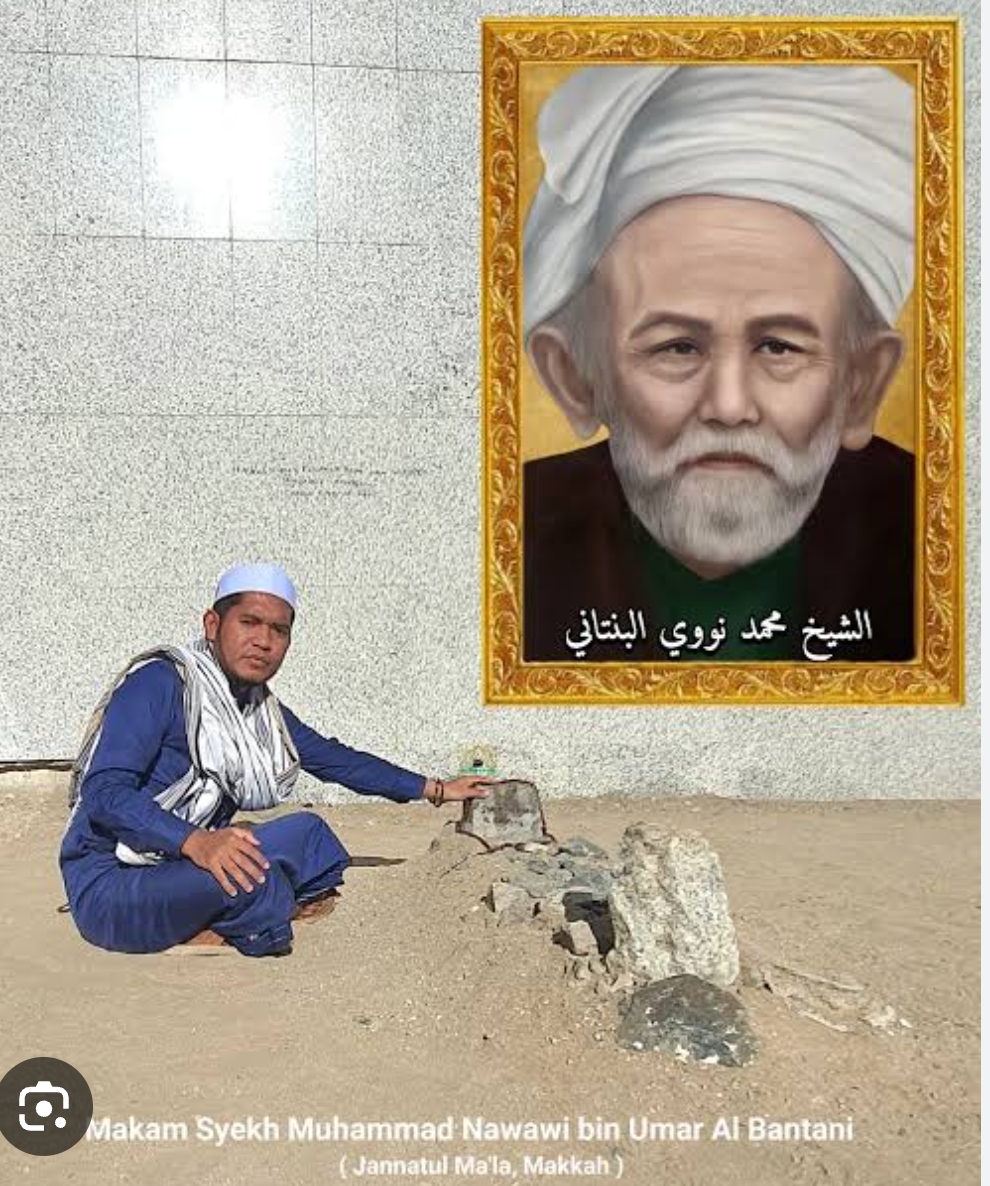
#Reflecting on the Colonial Bias Still Living Inside Us
Banten is marâh labîd—“a resting place for birds that come and go.” Marâh Labîd is also the title of Sheikh Nawawi Banten’s thirty-volume Arabic Qur’anic commentary. Since the late nineteenth century, that work has been published by Middle Eastern presses—and, of course, by Indonesian publishers as well.

Following in Sheikh Nawawi’s footsteps, we may read Banten as “a resting place for birds that come and go,” a place where ideas and the spirit of an age briefly perch, catch their breath, and then take flight again bearing new messages. In that metaphor, Banten appears not merely as a geographic region, but as a cultural space that receives, tends, and sends forth spiritual and intellectual energy into the open sea.
And now, at the harbor of Banten, the ringing of two bells sounds out—clear, forceful, but pitched differently, and coming from different directions. The sea of Banten knows that one of those bells tolls from Mecca, the other from the Netherlands.
History, though, has often heard one of those tolls more clearly, while allowing the other to reverberate in silence—a distortion that lays bare the colonial bias embedded in our memory. Amid the rippling water, Sheikh Nawawi and Multatuli are the tolling bells of the nineteenth century, still answering one another in the twenty-first. Their imagined conversation is an unfinished inheritance, an invitation not only to listen, but to ask: why is one voice remembered with grandeur, while the other must be excavated from layers of historical dust?
So from the harbor of Banten, we set sail far away—to Mecca. There, on the threshold of the holy land, we follow the path of a child from Tanara who would one day offer himself as a glowing ember of anti-colonial resistance—not with blades or cannons, but with a pen: Sheikh Nawawi al-Bantani.
He chose a different battlefield—not the chaos of open combat filled with the roar of artillery, but a quiet room lit only by an oil lamp. There, with ink and patience, he built a fortress no army could tear down. Every stroke of his pen was a tactic of resistance; every book that came from his hand was ammunition to defend the dignity of a people who, at the time, did not even yet have a name. From his modest room in Suqu ’l-Lail, Mecca, he sent out not troops, but ideas. He sparked not physical war, but a revolution of consciousness. The pen became his weapon, sanad his network, and tawhid the ground from which he launched every assault against injustice.
He left his homeland not to flee colonial rule, but to seek knowledge so that one day he might awaken the soul of a people not yet called a nation. He carried no weapon, only a pen and memory. Yet from afar, he laid the quiet foundations of nationalism long before the word itself was familiar to the tongues of ulama—or even to the pens of intellectuals. Here, the term nationalism is used heuristically, not anachronistically.
Then from Mecca we sail to Amsterdam, where we meet a very different figure: Eduard Douwes Dekker, known to the world as Multatuli. He was no cleric, no spiritual guide, but a troubled former colonial official. If Sheikh Nawawi wrote out of the clarity of faith, Multatuli wrote out of a wounded conscience. Their pens came from distant worlds, yet both scratched at the walls of colonialism from opposite sides at once: one fortifying the inner life of the colonized, the other unsettling the conscience of the colonizer.

The two men never met in actual history. But that is precisely what makes it so compelling to place them side by side in an imagined history. They did not know one another, did not read one another, never sat at the same table. Yet while Sheikh Nawawi was teaching Qur’anic exegesis in the colonnades of the Grand Mosque, Multatuli was writing the story of Saijah and Adinda in a rented room in Europe. They did not speak to each other, but history allowed their voices to echo across the distance.
Though they lived in different places, they lived in the same era. When Max Havelaar was published in the Netherlands in 1860, Sheikh Nawawi was fifty-two years old—an age of full maturity for a scholar. They may never have heard each other’s names, but the age they breathed was the same: an age when colonialism stood at the height of its power even as it was beginning to be challenged from the depths of human conscience. One built an argument for justice from proofs and chains of transmission; the other built resistance through satire and irony. They never greeted one another across a table, yet history brought them together in the same time—like two bells struck from different directions, producing the same tremor of sound, though in different keys.
We are not artificially pairing two figures here. We want to hear the resonance they produced and ask: how is it that a cleric who never uttered the name Indonesia, and a colonial writer who never set foot in Tanara, became two of the earliest pillars of our national consciousness? They never met, yet the sea of Banten today can still hear them calling to one another from afar. And that is where our voyage truly begins—not by asking who contributed more, but by listening to how each of them speaks to the future.
Sheikh Nawawi Banten: The Womb of Nationalism in the Holy Land
Tanara bore witness when that baby was born in 1813. He grew up in that village, a place ringed by rice fields and rivers, far from the centers of power but close to the center of meaning. From the womb of that land, the young Sheikh Nawawi grew as the son of a village religious official, absorbing knowledge not only from books, but from a simple life steeped in wisdom. The wind of Tanara and the soil of Banten carried him when he sailed to Mecca while still young. He did not bring ambition. He brought a deep longing for a liberating knowledge.
In the holy land, he eventually became an imam at the Grand Mosque and a teacher to hundreds of students from the archipelago and the wider Islamic world. Yet though his body settled in the Hijaz, his spirit kept returning home to Banten. He wrote book after book—on jurisprudence, exegesis, ethics—each one becoming a lamp for pesantren back home. He wrote as though whispering, “Through this ink, I am always on my way home.”
In his small house in Suqu ’l-Lail, Mecca, Sheikh Nawawi taught more than two hundred students from across the archipelago. He did not hand them weapons; he gave them exegesis. He did not teach the strategy of war; he taught the jurisprudence of justice, the ethics of courage, and a tawhid that refuses to bow before anything other than God.
In every letter he wrote, there was a quietly inserted ember: that knowledge is itself a form of resistance, and that injustice cannot thrive on soil guarded by enlightened souls. He did not begin resistance with weapons, but with a pen writing in silence. He did not protest through speeches, but through exegesis that shaped the soul.
The trees of Tanara and the sea of Banten bear witness: Sheikh Nawawi breathed that spirit out not only across Banten, but throughout the archipelago.
His modest home became the ground where the seeds of national consciousness were planted, where the grains of patriotism were sown. Those seeds would one day grow into the tree of nationalism—a nationalism that, in the hands of his spiritual disciples, would wrestle fiercely with colonialism.
The house was not large in physical size, but inwardly it was vast—because there, the spirit of a nation was shaped not through power, but through patience. From that room, waves of knowledge spread to Tanara, to Caringin, to Bangkalan, across the whole archipelago. They carried a spirit of patriotism that would later mature into Indonesian nationalism. That house was a womb of history: narrow for the body, immense for the soul. From it were born guardians of the national spirit. Sheikh Nawawi Banten was a womb of patriotism and nationalism.
How, then, did Sheikh Nawawi plant the seeds of national feeling, love of home, love of country, patriotism?
Nationalism as a word was still unknown in the histories of that age. The dawn of Indonesian nationalism had not yet broken; it still lay beyond the dark horizon of history. Yet in his works, Sheikh Nawawi explicitly referred to himself as at-tanâri dâran—“a man of Tanara”—and al-bantani iqlîman—“from Banten.” More than that, he even called himself al-jâwi—“a man of the Malay-Indonesian archipelago.”
This was more than a simple expression of homesickness. Through those self-attributions, Sheikh Nawawi quietly planted a sense of collective identity that reached beyond geography. From faraway Mecca, he built a narrative of belonging through spiritual and cultural language, turning origin into a matter of honor and responsibility. In every mention of his local and regional identity there is an implied invitation: love of homeland is part of faith and service.
It is important to note that these references to Tanara, Banten, and Java—that is, the archipelago—appear in the body of his own texts (see, for example, Syarh Kâsyifah al-Sajâ, p. 2). In other words, they are not editorial or publisher additions, but Sheikh Nawawi’s own words. That matters. It shows that geographic and cultural identity were not incidental markers of origin, but a self-conscious affirmation he deliberately inscribed.
When a great scholar living far away in Mecca calls himself al-Tanârî, al-Bantanî, or al-Jâwî, he is building a symbolic bridge between the land of his birth and the global center of Islamic learning. At the same time, this rejects intellectual anonymity: he wanted to be known as belonging to the archipelago, not dissolved into Arab cosmopolitanism alone. Here we see the embryo of national consciousness—the courage to name one’s homeland as a source of dignity and identity.
It is also worth noting that compared with calling himself a man of Tanara or Banten, Sheikh Nawawi more often explicitly described himself as al-Jâwî, “a man of the archipelago” (see, for instance, al-Tsimâr al-Yâni’ah fî al-Riyâdl al-Badî’ah, Nashâih al-‘Ibâd, and Fath al-Majîd fî Syarh al-Durr al-Farîd). That suggests that his longing for home expanded into a collective identity that moved beyond village and region.
By calling himself al-Jâwî, Sheikh Nawawi affirmed that he belonged to a broader imagined community: the world of islands that would one day be called Indonesia. This identity was not merely geographic. It was a spiritual pledge that the knowledge he taught was meant to liberate Muslims in distant lands—from Sabang to Madura, from Banten to Maluku.
This nisbah carries a transregional vision, a still-vague but already-rooted seed of national belonging, in which “Java” functioned as a metonym for the whole archipelago. So every word born from his hand did not simply return to Tanara; it sailed across the archipelago, nurturing an imagination of nationhood larger than anything he himself may have lived to see.
In fact, Sheikh Nawawi’s attribution to three regions at once—Tanara, Banten, and the archipelago (Java)—was unusual in the Islamic tradition of geographic affiliation. Normally, a nisbah refers to one place of origin or residence, serving as a marker of identity, scholarly lineage, and cultural belonging. This pattern was established from the earliest Islamic period: Salman al-Farisi was linked to Persia, Habsyi bin Harb al-Habsyi to Abyssinia. Later scholars maintained the same convention by affiliating themselves with just one place, whether birthplace or residence. Ibn Qudamah al-Maqdisi (d. 1223) was linked to Jerusalem, Abu ‘Abdillah al-Qurthubi (d. 1273) to Cordoba in al-Andalus, Ibn ‘Atha’illah al-Sakandari (d. 1309) to Alexandria in Egypt. In that tradition, the nisbah was a clear, singular claim to identity.
That is why Sheikh Nawawi’s decision to identify himself not only with Tanara, his birthplace, but also with Banten and the archipelago, marks a deliberate departure from convention. This double—even triple—nisbah suggests that he was not simply locating identity in the narrow locality of origin, but affirming historical, religious, and cultural connectedness to a larger social space. Through those attributions, Sheikh Nawawi was imagining himself as part of a broader collective that stretched beyond his village. That is where the seed of national consciousness begins to grow.
It should also be noted that on the inner title pages of almost all his books, the works are identified as those of Nawawi al-Jâwî (see, for example, Marâqî al-‘Ubûdiyyah, Tîjân al-Durârî fî Syarh Risâlah al-Bâjûrî, and Salâlim al-Fudlalâ’ ‘Alâ Hidâyah al-Adzkiyâ’ ilâ Tharîq al-Awliyâ’).
The attribution al-Jâwî on those title pages may well have been supplied by editors or publishers rather than Sheikh Nawawi himself. But that only reinforces the point: publishers and readers alike recognized and confirmed al-Jâwî as inseparable from his scholarly authority.
So this identity was no longer merely a personal claim. It had become a collective stamp, one acknowledged by the book market and the print tradition. In that way, al-Jâwî became something like an intellectual-spiritual brand, as well as a collective identity: a sign that Sheikh Nawawi’s works belonged not only to the general Islamic world, but also represented a voice from those distant islands called the archipelago. It was in this sense that Sheikh Nawawi planted the seeds of nationalism.
At the same time, his interpretation of the Qur’anic phrase ulî al-amr in Marâh Labîd shows that he never turned a blind eye to the socio-political dimension of the Qur’an. For him, ulî al-amr was not simply a symbol of obedience to rulers, but a grave trust that is only valid when grounded in justice, concern for the people, and fidelity to the divine law. He stressed that oppressive rulers or those who abuse authority do not, in fact, qualify as ulî al-amr. As recent scholarship has shown (Khuluqi, 2020), this interpretation offers an implicit critique of rulers who neglect their trust and oppress the people.
In Marâh Labîd, Sheikh Nawawi (1998a: 204) writes:
والمراد بأولى الأمرجميع العلماء من أهل العقد والحل وأمراء الحق وولاة العدل. وأما أمراء الجور فبمعزل من استحقاق وجوب الطاعة لهم …. قال بعضهم: طاعة الله ورسوله واجبة قطعا، وطاعة أهل الاجماع واجبة قطعا، وأما طاعة الأمراء والسلاطين فالأنثة أنها تكون محرمة لأنهم لا يأمرون إلا بالظلم، وقد تكون واجبة بحسب الظن الضعيف.
“What is meant by ulî al-amr is all scholars among those vested with authority to bind and loose affairs, the leaders of truth, and just rulers. As for tyrannical rulers, they are entirely excluded from deserving obligatory obedience…. Some scholars have said: obedience to God and His Messenger is categorically obligatory, and obedience to the consensus of the community is categorically obligatory. As for obedience to rulers and sultans, the default ruling is that it is forbidden, because they command nothing but injustice, though in rare cases it may become obligatory on the basis of a very weak presumption.”
This exegesis shows that Sheikh Nawawi did not recognize political authority built on injustice, and therefore implicitly delegitimized the colonial government that oppressed the people. He also placed the scholars among the ulî al-amr—that is, among the moral-political authorities of the community—imagining a community of leadership broader than the state alone. That is the moral-political foundation we may read as the embryo of Sheikh Nawawi’s nationalism: a collective consciousness that the community should submit only to just authority, and reject unjust rule, colonialism included.
From here it becomes clear that Sheikh Nawawi was not merely a “bookish scholar” in some dry sense, but a cultivator of political-moral ideas. His criticism of deviant rulers could be read as a mirror for people living under colonialism: rulers who oppress are not worthy of obedience. In this way, his exegesis of ulî al-amr sowed the seed of a collective awareness that the community has the right to demand justice from whoever rules over them. He planted a moral nationalism—the conviction that communal identity and homeland can stand upright only when leaders uphold trust. In the hands of his students, that teaching developed into real energy of resistance in history, becoming a collective moral summons of imagined commonality in the face of colonialism—from the Banten Peasant Revolt of 1888 to the Jihad Resolution of Surabaya in 1945.
We need to place Sheikh Nawawi in the context of modern theories of nationalism that emerged in the West, because the ideas and sensibilities of his time did not develop in a vacuum. He planted his seeds of nationalism in the nineteenth century, when the world was moving in a new direction, marked by the rise of national consciousness and the will to form nation-states.
Hans Kohn (1955: 11) argued that since the late eighteenth century, nationalism in the modern sense had come to be understood as a generally recognized collective feeling, and from then on “nationalism played an ever-increasing role in shaping all aspects of life.” From Europe, the nationalist spirit spread across the world.
So when Sheikh Nawawi was writing and building his intellectual networks, he was living within a global current undergoing a deep transformation in how human beings imagined community, negotiated sovereignty, and defined shared identity. The nineteenth century was not only the era when nationalism grew in Europe; it was also the period when those ideas began to affect colonies in Asia and Africa, including the Dutch East Indies. It is in that landscape that the seeds of religious nationalism planted by Sheikh Nawawi acquire their historical relevance.
We also need to place Sheikh Nawawi within Benedict Anderson’s framework of nationalism, since Anderson provided one of the most influential theoretical foundations for understanding the nation. In Imagined Communities (1983), Anderson argues that the nation is not a natural entity but a social construct—an “imagined community.” It is imagined because its members do not know one another directly, yet still feel themselves part of a single collective. What makes that bond possible, Anderson argues, is a shared experience produced by modern media, especially print, through what he calls print capitalism. Publications circulated through print capitalism unify language, discourse, and political imagination.
For Anderson, print media creates a space of simultaneous experience. A person reading a newspaper in Java and another reading one in Sulawesi, though they never meet, can feel that they inhabit the same time, the same space, the same reality. This is what he calls homogeneous, empty time—the modern linear concept of time that makes national consciousness possible. Mass-printed vernacular languages replace the dominance of Latin or Old Javanese, enabling people to imagine themselves as part of a broader community.