
The voice born from the pen name Multatuli—“I have borne much suffering”—became an echo crossing boundaries, from European reading rooms to fields once wet with the sweat and tears of the colonized. The book became more than literature. It became an existential confession: suffering can be carried, written down, and turned into a moral weapon. From then on, the name Multatuli stood as proof that words can crack the walls of power, and that one person’s courage to testify can give meaning to millions whose voices have been silenced.
In a banquet of Bantenese indigenous officials, Max Havelaar—the novel’s character—delivers a long speech. It is worth noting that he does not speak in the dry, rationalistic style of Europe, but in a religious rhetoric familiar to the ears of Muslim Javanese aristocrats. This shows rhetorical intelligence: instead of lecturing from a colonial height, he chooses to speak in the language of faith, touching collective conscience. In that way, political criticism becomes a moral summons difficult to brush aside. It is striking that Max Havelaar’s speech carries Islamic undertones, suggesting that Multatuli knew exactly to whom his fictional character was speaking (Multatuli 1991: 112–114):

“…
But I see that your people are poor, and that gladdens my conscience.
For I know that Allah loves the poor, and that He bestows wealth upon those whom He wishes to test, but to the poor He sends those who bring His word, so that they may rise in their poverty.
…
Yes, yes, yes, I say to you that your soul and my soul are saddened by it; and for that very reason we give thanks to Allah that He has given us power to work here.”
Multatuli opened a space for the Dutch to see the face of colonialism that had long been hidden behind the rhetoric of “civilization” and “progress.” He wrote not as an activist, but as a witness who could no longer remain silent. Telling the story of a colonial official who directly witnessed the suffering of the people of Lebak, as a result of the Cultivation System and the abuse of local authorities, the novel is more than a story. Max Havelaar is a moral summons, a call for the Dutch to ask: in whose name do we colonize?
The sharpest target of Max Havelaar is the colonial forced cultivation policy in the Dutch East Indies. Originally praised as the measure that restored Dutch finances after the Napoleonic wars, in practice the system became an engine of exploitation that drained the labor, time, and even lives of the colonized. Multatuli saw firsthand how people were forced to grow export crops such as coffee and sugar cane, not for their own welfare, but for the enrichment of a distant European metropolis. That suffering wounded his conscience and pushed him to write not merely as a novelist, but as a moral witness.
Through Max Havelaar, Multatuli did not only criticize. He also reconstructed the identity of “us.” Here, this new “us” is no longer the Dutch as colonizers, but a moral community of upright, conscientious Dutch people facing off against “them”: corrupt colonial actors and cruel indigenous collaborators. In Steven Grosby’s framework, this is a classic mechanism of divisiveness: a new solidarity formed through moral opposition.
Though certainly not the only factor, the impact of Max Havelaar was unmistakable: the Cultivation System, in effect since 1830, was officially ended in 1870, exactly a decade after the novel appeared. Beyond that, it helped pave the way for the Ethical Policy in 1901—the Dutch colonial policy framed as a moral responsibility to improve indigenous welfare. So the novel proved that words can shake a ship of power that seems immovable, no matter how great the waves or how fierce the wind.
In that sense, Multatuli deserves not only appreciation, but even a certain glorification. Recognition of him does not arise from emotional hero worship, but from the concrete record of how a literary work managed to pierce both the cultural sphere and the sphere of policy. Even the most cynical critiques of Max Havelaar ultimately cannot deny that the novel opened an ethical conversation that colonial interests had previously shut tight. It showed that anger, when written with stylistic force, can carry historical legitimacy.
Put simply, Max Havelaar is literature that challenges and tears. It challenges the voyage of the colonial ship and tears its billowing sail. It arrives like a storm revealing how fragile the foundations of celebrated imperial glory really were: that behind the thunder of cannons, the glitter of spices, the aroma of coffee, the sweetness of sugar cane, and the official reports swollen with pride, there lay stories of oppression tight enough to stop the breath. The novel lit a kind of moral compass pointing elsewhere—not toward the imperial harbor of glory, but toward a pier of justice for those who had never been heard. After that, the great ship of colonialism could no longer sail in peace, because Multatuli’s words had ripped its sail of arrogance and left a tear that could not be mended.
In that sense, Max Havelaar is not just a novel. It is repentance written in the ink of conscience—ink flowing from pain, from guilt, from an awakening that came late but was sincere. Multatuli is a repentant eye and a conscience that writes: he looked back at the land he had once left, the people he had once represented, the system he had once served. He wrote not out of triumph, but out of admitted failure. In every sentence there is the trace of regret seeking redemption, a hope that words might become light for the oppressed. And perhaps, in that repentance, he was writing not only for the people of Lebak, but for himself as well—for the chance to become a more honest, more sensitive, more responsible human being. Max Havelaar is a novel that indicts, but also a tract that prays; a confession that does not ask forgiveness, but offers awareness. That is where Multatuli remains relevant: not because he was flawless, but because he dared to face the wound and write it.
It is no surprise, then, that both in the Netherlands, where he came from, and in Rangkasbitung, where the wound began, museums stand in his name—not merely as tributes to a writer, but as reminders that morality can arise from within a corrupt system, and that guilt can be the first step toward awareness. These museums are quiet spaces holding an echo: that words can resist, that a novel can become a manifesto, and that the wounds of history can be turned into lessons of conscience.
The Multatuli Museum in Amsterdam, located at Korsjespoortsteeg 20hs, stands in the very house where Eduard Douwes Dekker was born—a modest old building now revived as a space of memory. On its official site, the museum states that its purpose is to keep Multatuli alive in memory. Its collection includes personal objects once touched by the writer himself: the writing desk where he poured out his unease, the globe marking the world he criticized, the bookcase holding the pulse of his intellectual life. There are no flashy digital screens or glossy modern installations; its very simplicity forces visitors into an honest encounter with history. The museum does not shout about colonialism. It offers silence. And in that silence, we hear more clearly the voice he once wrote: that moral courage can be born in a room no larger than a study. In that museum, Dutch visitors may well read the traces of Eduard Douwes Dekker as the trace of historical remorse.
Meanwhile, the Multatuli Museum in Rangkasbitung, on Jalan Alun-alun Timur No. 8, welcomes visitors into a space where history breathes in stillness. Among the walls of a former district office, one can sense the trace of Multatuli—books, documents, and interactive monuments presented not simply to be looked at, but to be felt through a living local narrative. The low admission price for local visitors (Rp2,000 for the public, Rp1,000 for students) reflects that this is no elitist museum, but a shared space for holding memory in one’s hands. Through its galleries, the past of Lebak rises: coffee plantations, colonial relations, and the moral conflicts of ordinary people who had no stage from which to speak. This museum does not whisper the past as an old fairy tale. It creates a resonance in the visitor’s chest that colonial wounds are not the property of a bygone era, but a foundation whose effects still creep into the present. In this museum, indigenous visitors may read Multatuli’s traces as a blow not yet fully paid back.
But moral courage always carries another question with it: who has the right to speak for whom?
In Banten, Max Havelaar is not only a moral icon, not only a confession, not only a repentance. It is a wound writing itself. In a land that once witnessed Sultan Haji’s betrayal and the exile of Sheikh Yusuf, Multatuli does indeed appear as both guilt and an internal voice of protest from within the colonial ship. But more than that, Banten’s wound is now writing itself, speaking its own pain. Multatuli did not merely narrate the suffering of Banten’s peasants and the cruelty of the colonial Cultivation System; he also exposed the cruelty of local actors who profited from the suffering of their own people.
And that is where the irony—and the pain—settles. Oppression does not come only from afar, from foreign lands arriving with iron ships and tricolored flags. It can also come from close at hand, from fellow children of the soil who ought to have been protectors. The wound of Banten, as etched by Multatuli, is layered: colonial oppression, and local collaboration stabbing from behind. So when Max Havelaar is reread on this soil, it is no longer simply a story about the Dutch and colonialism. It is also a bitter mirror showing how power, without conscience, can become betrayal of one’s own people.
Multatuli still lives in the land of Banten—not merely as a foreign name from history books, but as a pulse beating through memory and collective hurt. He is there as a whisper warning us that injustice once settled here, and may return if the voice of the people is silenced again. The wound no longer lives only in texts or museums; it beats in cultural memory. It reminds us that history is not a finished page, but a mark still wet on the body of the nation. To read Multatuli in Banten today is to let that wound speak again—not to wallow in it, but to turn it into testimony: that justice is always born from the courage to face truth, however painful.
And yet the glorification of Multatuli carries an epistemic problem of its own: he remains a Dutchman speaking on behalf of the colonized. So we must ask: is Max Havelaar truly a voice of resistance, or only a form of “colonial repentance” that still leaves the Indies as an object of narration? Does Max Havelaar genuinely reject colonialism, or does it merely seek to reform it so that colonialism may endure?
Sheikh Nawawi planted a primordial sense of nation without naming Indonesia, while Multatuli criticized colonialism from the comfort of Europe—two voices answering one another without ever meeting, yet together, and ironically, helping shape our reflective imagination today.
A Reflection for Today
From Amsterdam, let us return home to Banten. At the harbor of Banten, we hear those two bells toll again, answering each other again. Once we place Sheikh Nawawi and Multatuli within a single comparative horizon, their starting points appear radically different. Sheikh Nawawi speaks from the veranda of the pesantren, from exegesis and jurisprudence, from a world of religious literacy woven into the spiritual pulse of his people. Multatuli, by contrast, speaks from the desk of colonial bureaucracy, from the disappointment of a civil servant whose moral conscience was offended by the arbitrariness of the system. Both voices question colonialism, but they do so in profoundly different languages and toward very different ends.
Through Max Havelaar, Multatuli did indeed jolt the Netherlands. He stripped bare oppression, showed the painful face of the Javanese people, and for that reason has often been idealized as a moral hero. But as Edward Said (1993: 240) and a range of postcolonial readings of Max Havelaar have pointed out, Multatuli’s critique remains trapped within a colonial horizon: he does not reject colonialism itself, but asks that it become more humane, more just, more moral. In other words, his criticism is aimed not at destroying colonialism—not at sinking it to the floor of the Banten sea—but at preserving it by repairing its ugliest flaws.
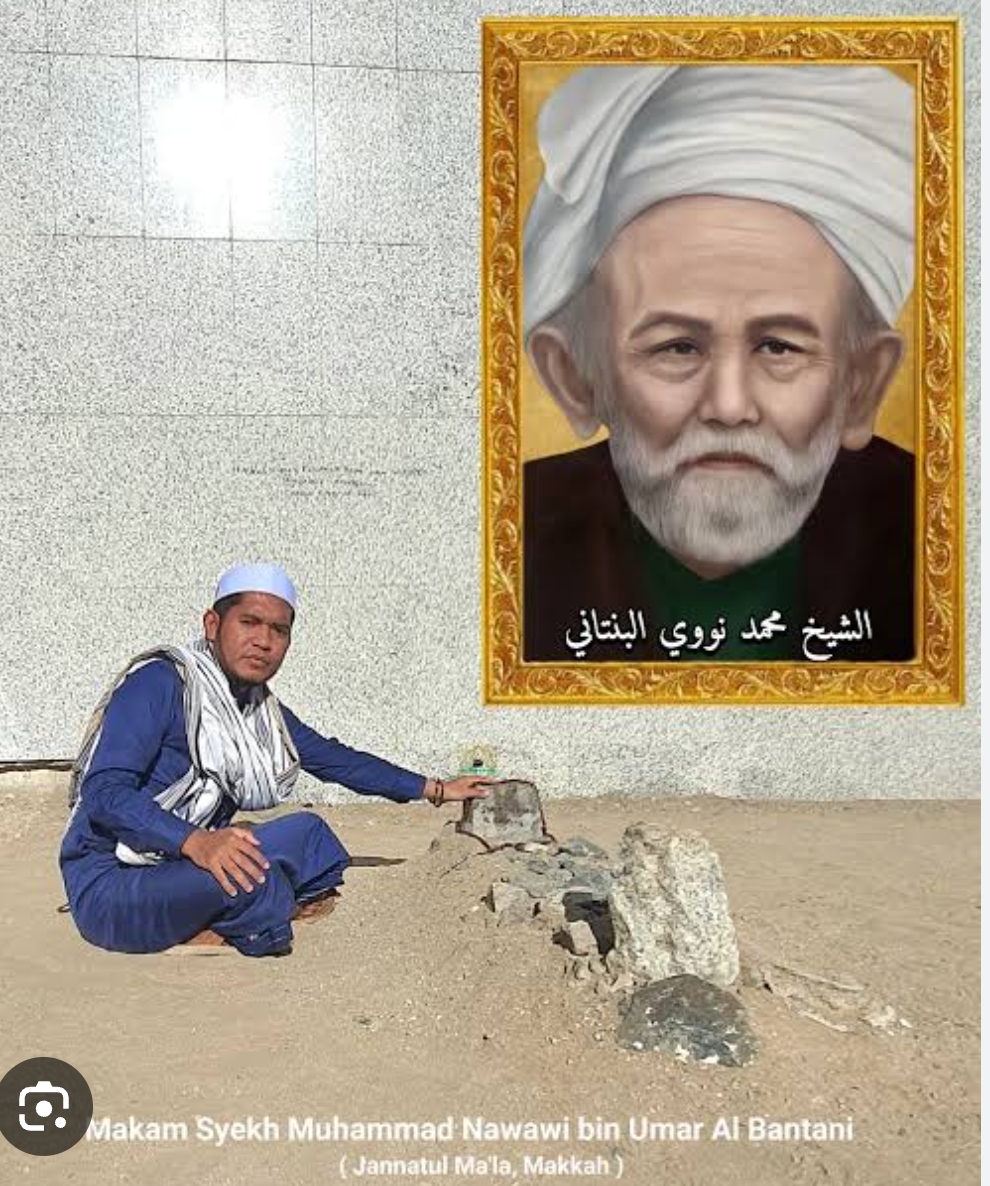
Sheikh Nawawi, on the other hand, wrote no novel and gave no speech in the Dutch parliament, yet his voice is sharper in its antagonism. He rejected colonial authority as illegitimate government; he refused the subordination of religion under a structure of exploitation; he valued the Acehnese struggle and the revival of the Banten sultanate. These are not simply moral hints, but articulations of anti-colonial consciousness rooted in faith. Sheikh Nawawi speaks from the standpoint of the colonized resisting, not from the internal self-correction of the colonizer.
To read Sheikh Nawawi and Multatuli today is not merely to measure who opposed colonialism more forcefully. It is to realize how colonial horizons still blind us. Sheikh Nawawi teaches that resistance can live in prayer, exegesis, and fatwa; Multatuli reminds us that even within the colonial body there may be moral fractures. But only by placing them side by side can we see how wide the anti-colonial horizon of the archipelago truly is—from the desk of the colonial bureaucracy to the verandas of village pesantren.
Multatuli voiced a sharp critique of forced cultivation and the arbitrariness of local officials. Yet his critique remained rooted in the framework of “a fairer colonialism,” not the abolition of colonialism itself. He did not imagine Banten or Java as free societies, but as peoples who ought to be ruled with European morality. His bias is subtler: he sides with the people, but still from a paternalistic colonial tower. Put plainly, Multatuli’s sympathy for the victims of colonial cruelty, and his criticism of colonial bureaucracy, still carry a colonial tint.
Only when we become aware of this colonial bias can we begin to raise figures like Sheikh Nawawi not as distant shadows, but as subjects speaking in their own anti-colonial language. Looking again at Sheikh Nawawi and Multatuli, we also see our own bias: the moral voice from the colonial veranda sounds louder to us than the moral voice from our own porch. That is the most piercing point of reflection. We keep hearing the echo of Multatuli—from the benches of the Dutch parliament to colonial history books—while the voice of Sheikh Nawawi fades behind the study tables of pesantren, half-hidden in exegesis and legal opinion.
That is not because Sheikh Nawawi was less clear or less incisive. It is because our historiographical ears are better trained to hear voices from the colonial bedchamber than voices from the chairs of our own homes. Multatuli’s moral voice feels explosive because it vibrates in the metropolitan spaces of Europe. His ethical appeal sounds loud because it is delivered in a language colonial power understands, even though it speaks from inside the colonial house. His desire to preserve colonialism remains muted. Sheikh Nawawi’s voice, meanwhile, echoes in small spaces absent from colonial archives, in the verandas where santri copied texts by hand. It is quieter, yes—but precisely because of that quiet it escaped colonial classification and lit the fire of consciousness in the husk of the common people.
By comparing them—Multatuli and Sheikh Nawawi—we are really looking at our own bias in the mirror. We are used to treating the colonial as the center of meaning, even when speaking of anti-colonialism. We quote Multatuli with great reverence, yet often fail to read Sheikh Nawawi as an autonomous source of political thought. And exactly at that point of bias lies the irony: we have a Multatuli Museum, but have forgotten to build a house of memory for Sheikh Nawawi—just as we forgot to build one for Sheikh Yusuf Makassar. That, ironically enough, is the colonial bias still lodged inside us to this day. Colonialism did not leave behind only physical and political traces; it also shaped the way we decide who is worthy of remembrance.
The Multatuli Museum stands proudly in Rangkasbitung, celebrated as a monument to colonial critique. But Sheikh Nawawi, who consistently refused submission to colonialism and ignited anti-colonial consciousness from the verandas of pesantren, we have not even imagined honoring with a house of memory. This irony strips bare the colonial bias still planted in us: we are quicker to celebrate moral ink flowing from colonial rivers than moral ink rising from our own sea.
That is how we swallow the bitter pill of colonial recognition politics. Those who speak in the language of colonial archives are given the stage, while those who speak from village prayer halls are pushed aside. This is colonialism’s subtlest inheritance: the way we remember history, the way we choose who deserves to be remembered. If we truly want to be free, then at the very least Multatuli must be placed alongside Sheikh Nawawi—not as his shadow, but as two different faces of the anti-colonial struggle.
Perhaps this is how history works: it does not always slap us violently. Sometimes it drips slowly, like poison dissolved in a glass of honor. We do not feel the bitterness as we swallow it, because it comes labeled celebration, festival, moral hero. We think we are being fair, while without realizing it we are deciding who deserves to be kept alive and who may quietly be erased from memory. Colonialism works with remarkable elegance—even in something as seemingly noble as deciding who is more poetically remembered.
Let us look once more at Banten. On one side, the Multatuli Museum stands grandly, complete with a heroic narrative about a Dutchman who spoke for the colonized. On the other side, we do not even know where Sheikh Nawawi’s childhood home stood, much less have we restored it into a space of memory. We immortalize the colonial who wrote concern, but leave unmarked the cleric who wrote resistance in a language we no longer read. We have spent so long learning to praise what is loud that we forget the steadiest souls are often those who choose to speak softly. That irony is too quiet to call a scandal, but too painful to ignore.
So what should we do?
The Cultural Heritage Preservation Office (BPK) Region VIII Banten holds part of the answer. The BPK has worked hard to preserve collective memory along the Cibanten River—ecologically and historically—maintaining heritage sites and drawing visitors to places of historical significance. Region VIII Banten knows that Sheikh Nawawi is all of these things at once: river, cultural heritage, and site. He is a river: a spring of knowledge flowing powerfully from Mecca, making the whole archipelago fertile, watering souls gone dry beneath the heat of colonialism, even to this day. He is cultural heritage: the most precious living legacy, not in the form of stones or inscriptions, but in the form of a tradition of learning, moral steadfastness, and deeply rooted love of homeland. And he is a site: a coordinate point on the map of our civilization, which—even if his physical house has been forgotten—remains a spiritual center of gravity binding us to our identity as Bantenese, as Indonesians.
What we may need now is not merely a postcolonial perspective, but a decolonial consciousness: the courage to strip away the colonial biases still lodged within us. Colonialism did not leave wounds only in the past; it also planted ways of seeing that we have unconsciously inherited and even continued to cultivate. We repeat their ways of judging the world, of looking at ourselves through the borrowed eyes of the colonizer. Decoloniality is not just critique. It is the courage to look into the mirror and ask: to what extent are we still acting as agents of their ideas? Perhaps this is the hardest jihad of all—not resisting external power, but toppling the little throne of colonialism enthroned inside our own souls.
And even here, at the furthest point of this journey, the sea of Banten is still restless. The wind at the harbor still rises. At the end of the voyage, let it keep reminding us that colonialism works most subtly not at the port, but in the way we remember—and whom we choose to remember.
*This essay was delivered at a Poetry Recital event at the Kaibon Palace site, Serang, Banten, on October 25, 2025.
Author:

Jamal D. Rahman is a writer of poetry, literary criticism, and essays on literature, culture, and Islam. He also teaches literature at UIN Syarif Hidayatullah Jakarta.
He has served as Chair of the Literature Committee of the Jakarta Arts Council, Editor-in-Chief of the literary magazine Horison, and Editor-in-Chief of Jurnal Sajak. In 2016, he received the Southeast Asian Literary Award from the Minister of Education of Malaysia, Dato’ Seri Mahdzir bin Khalid.
His forthcoming books include Islam, Literature, and Knowledge: Contesting Colonial Discourses of the Banten Maritime World, Wahdatul Wujud: The Articulation of Islam in Modern Indonesian Literature, and an essay collection titled A Cup of Coffee for a Wayfarer.