
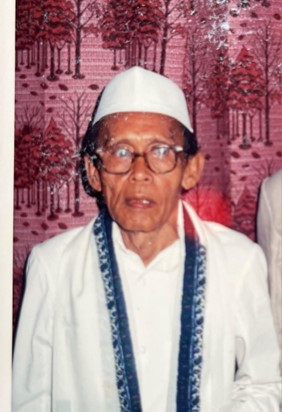
In Silo, Jember, East Java there stands an Islamic boarding school named Al-Hidayah Al-Imami Karangharjo. It was founded by a humble kiai, a man who never sat in a formal classroom, yet left behind a remarkably rich intellectual legacy: Kiai Haji Imam Nawawi Kafrawi.
His name may not echo loudly on the national stage. Still, among santri, village communities, and manuscript researchers, KH Imam Nawawi holds a quiet but undeniable significance. He was not merely a caretaker of a pesantren, but a prolific writer, someone who preserved his thoughts, anxieties, and ideological resistance through Arab-Malay (Pegon) script, written in the Madurese language.

KH Imam Nawawi was born in Madura in 1922. This detail comes from his membership record in the Nahdlatul Ulama Party, Jember branch, in 1959, where his age was documented. Little is officially recorded about his childhood, except that he grew up in a family deeply rooted in pesantren traditions.
Formal education never touched his path. Instead, the pesantren became his universe of learning—shaping both his intellect and character. He spent his longest years of study at Pesantren Annuqayah in Guluk-Guluk, Sumenep. It was here that Imam Nawawi was forged: immersed in classical Islamic texts, drawn into the depths of Sufism, and exposed to the social dynamics and ideological debates that colored his era.
After completing his studies, KH Imam Nawawi settled in Karangharjo, Silo, Jember. In this mountainous region, he established a pesantren that would later be known as Al-Hidayah Al-Imami. This was more than a place for transmitting religious knowledge, it became a cultural stronghold of Nusantara Islam, where Pegon manuscripts and Madurese poetic verses were written, copied, and passed down through generations.
Al-Hidayah Al-Imami stood as living proof of how a village kiai could evolve into both a guardian of knowledge and an organic intellectual. Through his hands, a small pesantren in Silo found itself connected to broader currents of thought, and even to the political turbulence shaping the nation.
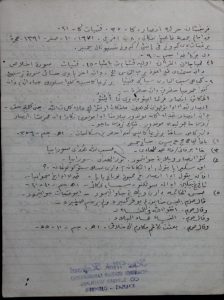
One of the manuscripts discussing an ANO meeting.
One of KH Imam Nawawi’s most striking qualities was his relentless productivity as a writer. The surviving records reveal just how expansive his intellectual horizon was. He did not limit himself to writing on Qur’anic exegesis, jurisprudence, or Sufism. Instead, he engaged with the defining debates of his time: imperialism, communism, authoritarianism, colonialism, and more.
What makes this even more compelling is his medium of expression. Every idea was written in Arabic-Pegon script using the Madurese language. For him, Pegon was not just a writing system, it was an instrument of cultural resistance. It bridged modern knowledge with local tradition. Through Pegon, Imam Nawawi wrote for santri and ordinary villagers familiar with the script, ensuring his ideas didn’t remain confined to elites but flowed downward, reaching the grassroots.
Beyond ideological writings, KH Imam Nawawi also composed syi’ir, poetic verses in Madurese. These poems documented key events, including local socio-political conflicts.
One such work captures the tensions between Fatayat NU (the women’s wing of Nahdlatul Ulama) and Gerwani (the Indonesian Women’s Movement), the women’s wing of the Indonesian Communist Party. This syi’ir was more than literature, it was a historical document, preserving how grand ideological clashes, between NU and communism filtered down into village life.
With a style that was both direct and sharply critical, KH Imam Nawawi articulated the collective anxieties of his time. Today, these verses function almost like an “alternative archive,” revealing dimensions of the 1950s–1960s that lie beyond official state narratives.
People often measure intelligence by diplomas or academic titles. KH Imam Nawawi walked a very different path. He never attended formal school, yet the breadth of his thinking left many in awe. His life stands as proof that the pesantren can be a university of life, a place where a village child can build a global horizon.
Through his work, the pesantren did more than produce devout individuals; it nurtured intellectuals, critical thinkers who questioned imperialism, colonialism, and every form of injustice. His ideas remind us that pesantren scholars are not merely guardians of tradition, but agents of social change.
Today, KH Imam Nawawi’s handwritten manuscripts still exist. Some have been studied by the Ngenger.co community, while others remain scattered among family members and former students. These writings are the traces of a village scholar who thought globally.
His legacy is not only the pesantren that still stands in Karangharjo, but also the Pegon manuscripts that record the great intellectual and ideological currents of the twentieth century. Through them, we witness how a village ulama responded to global issues, using a deeply local language.
KH Imam Nawawi Kafrawi is a living testament to how pesantren can produce intellectuals who are both grounded and worldly. From Madura to Silo, from pesantren to Pegon, from poetry to ideology, he carved a legacy that deserves to be rediscovered.
In an age overwhelmed by digital noise, his name gently reminds us that once, the pen, and the Pegon script served not only as tools of expression, but as instruments of resistance, and as a priceless cultural inheritance.