
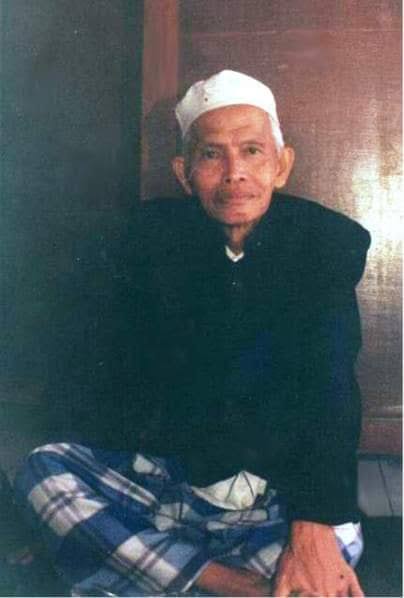
For people in Bantul—especially those around Wonokromo—KH Muhammad Abdul Muhith is hardly a stranger. Most simply knew him as Mbah Uhith, a name spoken with quiet familiarity and deep respect.
He was a scholar of fiqh, a guardian of Islamic legal thought, and the caretaker of Pondok Pesantren Al-Fitroh in Jejeran, Pleret, Bantul, Yogyakarta. But titles never quite captured who he was.

Born in 1936 in the village of Jejeran, Mbah Uhith grew up in a household steeped in scholarship. His father, KH Nawawi, was a respected cleric in Yogyakarta and had once served as the personal secretary to Sheikh Ihsan of Jampes, the author of Sirajut Thalibin. From an early age, young Muhith absorbed religious knowledge not only from his father but also from scholars across Wonokromo. Later, he continued his studies at the Watucongol pesantren in Magelang under the guidance of Mbah Kiai Dalhar—revered by many as a saintly figure.
Yet what truly set Mbah Uhith apart was not just where he studied, but how. He had a deeply ingrained habit of teaching himself. Left alone with books, he flourished. Nearly every text in his personal library passed through his hands, read with care, revisited with patience. His muthola’ah—that quiet, disciplined practice of studying independently—became something of a legend. Few could match it. Not even his own children.
What he read never stayed on the page. It lived on in his teachings. Whether inside the pesantren or beyond its walls, his kitab kuning sessions carried the weight of a lifetime spent in conversation with classical texts. If ever there was a man who read until his final breath, it was Mbah Uhith.
And he didn’t just read—he wrote. Prolifically. One of his most notable works bears the title Hiyadl ar-Rabihin fi Ma‘rifati Ma‘aniy Riyadl ash-Shalihin—a descriptive rendering of Riyad as-Salihin, the celebrated collection by Imam al-Nawawi. What made his work stand out wasn’t just its content, but its form. He wrote it in Arabic Pegon, using Javanese as the language of explanation.