
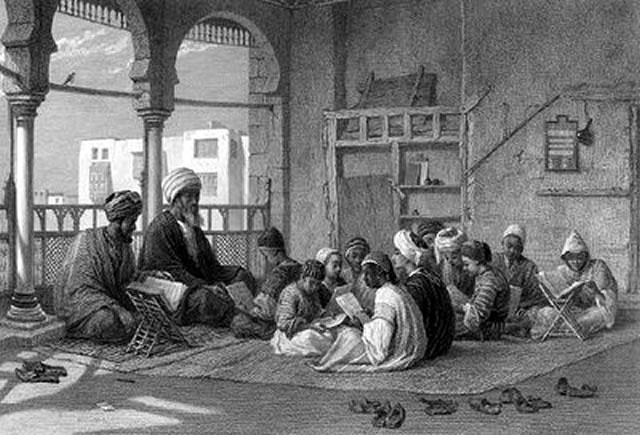
The idea of a network of ulama offers a powerful lens through which to read the history of Islam in the Indonesian archipelago. As far as I’m aware, Azyumardi Azra’s Jaringan Ulama (1993) stands as one of the earliest serious attempts to map this terrain. It’s no surprise, then, that the very notion of scholarly networks in the archipelago has become closely tied to his name.
Azra’s work shows how intellectual currents flowing between the Middle East and the Nusantara in the 17th and 18th centuries seeded a wave of Islamic renewal. The religious landscape of the time bore the imprint of neo-Sufism—a shift that gently steered local Islam away from a purely mystical orientation toward a more balanced synthesis, where spiritual practice and Islamic law moved hand in hand.
The Evolution of the Field
After Azra, the conversation didn’t stop—it widened. Later scholars began to revisit Islam in the archipelago through the same lens of scholarly networks. What Azra once described as a “neglected field” gradually found its footing. Not dominant, perhaps, but no longer overlooked.
Take Agus Sunyoto’s Atlas Wali Songo (2012). While not explicitly framed as a study of scholarly networks, it effectively maps one: the interconnected world of the Wali Songo. Sunyoto’s strength lies in restraint. He sidesteps the usual hagiographic tales of miracles and instead presents the Wali Songo as historical actors embedded in a living network—linked by shared missions, knowledge, and social ties.
Then there’s Amirul Ulum’s Al-Jawi al-Makki: Kiprah Ulama Nusantara di Haramain (2017), which, in many ways, picks up where Azra left off. Both explore networks formed in the Haramain, though across different centuries. Azra focuses on the 17th and 18th centuries; Ulum shifts the spotlight to the 19th and 20th. He frames this web as the al-Jawi al-Makki network—a continuation, not a repetition, of earlier scholarly exchanges.
Across these works, we can trace networks at both national and global scales—Wali Songo within Java, al-Jawi al-Makki across the wider Islamic world. Yet something often slips through the cracks: the local.
Azra himself once called this gap “the forgotten network.” And it’s a telling phrase. Because at the grassroots level—villages, coastal communities, remote regions—ulama have long shaped the lived texture of Islam in ways that are no less significant.
My own thesis, The Jiou Network (Local Ulama) and Islamic Patterns on the Southern Coast of Bolaang Mongondow, North Sulawesi, in the 20th Century (2021), tries to step into that silence. It traces the jiou ulama network and shows how deeply their influence runs—quiet, persistent, and formative in shaping local expressions of Islam along that coastline.
These works, taken together, sketch a larger picture. Islam in the archipelago did not spread in isolation, nor did it grow randomly. It moved through people—through scholars bound together in networks, visible and invisible alike.
How Scholarly Networks Take Shape
Drawing from Azra’s analysis in Jaringan Ulama Timur Tengah dan Kepulauan Nusantara Abad XVII dan XVIII, we can see that these networks tend to form in two distinct ways: directly and indirectly.
Direct networks grow out of tangible relationships—teacher and student, parent and child, in-law ties. They are personal, traceable, almost genealogical.
Consider the Wali Songo. Sunan Ampel and Sunan Bonang were father and son. Bonang, in turn, taught Sunan Kalijaga. Across the network, these lines of knowledge and lineage intertwine, forming a web grounded in both blood and learning.
Indirect networks are subtler. They emerge when scholars don’t share the same teacher, but their teachers do. Or when they draw from the same texts, inherit the same intellectual traditions, or orbit around a shared center of learning.
Again, the Wali Songo offer a telling example. Kalijaga studied under Bonang, who had studied at Ampel. Meanwhile, Datuk Ri Bandang, known for spreading Islam in eastern Indonesia, studied at Giri—whose founder, Sunan Giri, had also studied in Ampel. No direct link between Kalijaga and Datuk Ri Bandang—yet both are quietly connected through Ampel’s intellectual lineage.
This is how networks breathe: not always through visible ties, but through shared roots.
Why This Matters
The theory of ulama networks does more than map relationships—it reframes how we read history. Through Azra’s lens, the story of Islam in the archipelago becomes less about isolated figures and more about interconnected lives.
And that changes everything.
We begin to see patterns where there once seemed to be fragments. We understand how ideas traveled, how teachings evolved, how communities were shaped—not by chance, but through the steady presence of scholars working within networks that stretched across oceans and generations.
In the end, Islam in the Nusantara is not just a story of arrival. It’s a story of connection.